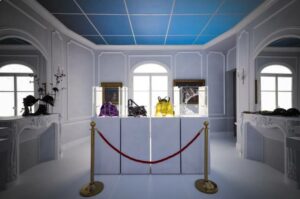
There are billionaires who collect yachts, and then there’s the Lord’s dynasty, who prefer to collect ceilings and Sienese bronzes. This week, the Lord of the Arnaults struck again. Destination: “The Frick.” Yes, the Frick Collection. The name alone sounds like an immensely wealthy American aunt who refuses gluten and has three Gainsboroughs in her living room. The Lord loves “The Frick” in French it’s chic.
So, on May 20th, Louis Vuitton will stage its 2027 Cruise show in this New York temple of Old Masters, 10 East 71st Street (between Madison and Fifth Avenues), New York, right in the middle of Rembrandts, Fragonards, and people who solemnly say “ravishing.”
This is the first time The Frick has hosted a fashion show. A historic encounter between two worlds that already shared the essentials: gilded frames, industrial fortunes, and a certain passion for fabrics that cost as much as a studio apartment in Villejuif.
At the helm is Nicolas Ghesquière, artistic director of Vuitton’s women’s collections, a great admirer of monumental spaces where one always hesitates between admiring the moldings or discreetly checking the price of a bag. Ghesquière loves to create a dialogue between architecture and fashion.
In the gardens of global beauty, India is now releasing a trail impossible to ignore. The great houses move forward like master perfumers searching for a rare new raw material: Estée Lauder has embraced the Ayurvedic elegance of Forest Essentials, while Unilever and L’Oréal continue to multiply alliances and acquisitions. Behind these strategic moves lingers the same intuition: India is no longer merely a market, but a fragrance of the future, an incandescent blend of botanical tradition, technology, and contemporary desire.
Paul Smith continues to modernize its leadership team with the appointment of Zia Zareem-Slade as managing director. Formerly head of Annoushka, and previously associated with Fortnum & Mason, Hauser & Wirth and Selfridges, she is known for her expertise in commercial growth, digital development and customer experience.
Over the decades,
On Sunday evening, the pitch will be upholstered in Alcantara, and the red lacquered studs will gleam against the black night: Stade Rennais will face Paris FC in a derby that will look less like football and more like a showcase from Place Vendôme than a corner shop in Aubervilliers. In the stands, no one will wave scarves. Instead, spectators will display “Dior J’adore” silk carré scarves like battle standards from a very expensive kingdom.
Beneath the carnivorous chandeliers of the Met, or the Mite Gala depending on one’s mood, where every gaze glints like a freshly sharpened blade,
Doris F. Fisher, who co-founded Gap Inc. in 1969 alongside her late husband Donald Fisher, passed away on Saturday in San Francisco at the age of 94.
So here come the new Pilgrim Fathers, no longer in black hats and silver buckles, but in logo-stamped sneakers and smoked lenses, gliding across the football tarmac like prophets of freedom. They are no longer fleeing religious persecution; they are fleeing boredom, taxation, and perhaps, ultimate horror, the absence of intelligent leaders.
I was leaving Paname at dawn, as one slips away from an oppressive dream in the manner of
In the shifting light of Biarritz, where the ocean seems to converse with the sky, Matthieu Blazy brought an old dream back to life. In this very place where Gabrielle Chanel first traced the outlines of her empire, he summoned the elegant shadow of Karl Lagerfeld and fulfilled what the latter had only imagined. The casino, transformed into a hushed sanctuary, became a stage of apparitions, where the world and its illustrious figures gathered to witness this dialogue between past and present.
There is, in the spirit of the times, an unexpected fascination with Gen Z. A segment of our younger generations, born into open and democratic societies, now seems to be looking elsewhere, toward authoritarian political models, with a curiosity that can sometimes feel unsettling. China, in particular, has become for some both an object of admiration and a source of questioning.

There are sentences that reek of the incense from the bonfire of vanities; these clearly belong to the chapel of industrial ego, where common heritage is mistaken for personal property. Thus, according to the “lord of the rings,” luxury would be nothing less than a sanctuary preserving the “identity,” “history,” and “cultural heritage” of an entire country… A rather spectacular rhetorical pirouette to define the French soul. Surprising, isn’t it?
The same question comes back every summer, like a stubborn mosquito in an overheated room: which swimsuits should one invest in for 2026? Invest, really. As if the bikini had become a safe haven asset, wedged somewhere between gold and government bonds, ready to withstand economic storms and Instagram tides.
Once upon a time, there was an enchanted kingdom where the air smelled faintly of burnt credit cards. In this realm, a house called Jimmy Choo decided it was time… to invent the seasons. After centuries of winter, summer, and falling leaves without any creative direction, someone clearly had to take control.


Beneath the arcades of the Galerie Vivienne, where light glides over the mosaics like an ancient confidence, stands a boutique one might almost miss… if its soul did not know how to call out. It bears a name, simply engraved, with an almost tender restraint: Spoturno.
The Ministry of Culture regularly offers support schemes aimed at helping French companies in the fields of couture, leather goods, jewelry, accessories, and watchmaking. On paper, the initiative sounds commendable: encouraging creativity, supporting talent, preserving craftsmanship. But a closer look at the eligibility criteria tells a different story.
From the very first moment, the visitor’s gaze seems seized by an invisible hand, held briefly in a suspension almost sacred, where a vast constellation of vermilion forms unfolds, their impulses appearing to converse with Gehry’s diaphanous sails, as though the architecture itself had consented to become breath. Nothing here weighs any longer according to the ordinary laws of matter: the sculpture does not impose itself, it breathes, it floats, it seems to listen to the very silence of space, and to merge with it like a thought made visible before the Lord.
Behind the scenes of luxury, Gucci is trying to stitch its narrative back together. Under the direction of Demna, newly arrived from Balenciaga, the Italian house is showing a flicker of recovery in North America (+7%), though not enough to conceal ongoing strains in Western Europe and China, where Kering acknowledges missteps in distribution and a loss of desirability.
On Monday morning, at that hour when the boulevards of fashion awaken with the languid grace of a well-fed beast, a piece of news slipped into hushed salons like a carefully orchestrated confidence. The house of Dolce & Gabbana, that theater of opulence where every stitch seems to conspire toward destiny, has summoned to its side a man of networks and measured silences: Stefano Cantino.
In the grand history of Parisian fashion, certain personalities leave a singular, almost electric imprint. Maud Frizon was one of them. I met her at a time when she was considering creating a perfume, while I came with all my expertise in bottle design. That encounter struck me with its simplicity and liveliness: she spoke of creation as a serious game, with sparkling eyes and a constant curiosity for materials, shapes, and sensations.
Paris, the world capital of fashion, macarons… and now, according to certain police scenarios, of financial laundering with a hint of Italian leather. We already knew about laundering in washing machines, tax laundering, and even artistic laundering. Now comes the latest trend of the season: laundering through luxury leather goods.
Have you heard that little tune? It returns with every conflict. A discreet yet persistent melody whispering that, in the storms of the world, some people never really get wet. The rich, it is said, are not the ones struck by the bombs. They stack their gold, their assets, and their fortunes into private jets, ready to take off at the first rumble in the sky.
In ports where the sea resembles a sheet of polished steel, containers rise in stacks like giant ideograms. Blocks of orange, blue and rust form a kind of industrial calligraphy that contemporary China writes across the oceans. It is within this landscape of global trade that Maison Margiela chose to stage its Fall 2026 show in Shanghai. A setting of docks and metal boxes, raw and monumental, as if the poetry of luxury had decided to converse with the machinery of world commerce.
Cartier has announced a three-year partnership with The King’s Foundation, the educational charity founded in 1990 by the then Prince of Wales, now King Charles III. The aim is not to produce more watches, nor to speak of growth or market share. The objective is simpler and far more precious: to pass on rare crafts.