
Doris F. Fisher, who co-founded Gap Inc. in 1969 alongside her late husband Donald Fisher, passed away on Saturday in San Francisco at the age of 94.
With quiet determination and visionary clarity, she helped transform a simple idea into a cultural cornerstone, reshaping the very language of American casual style. What began as a personal frustration, her husband’s search for a well-fitting pair of jeans, became the spark of an enduring adventure. Leaving behind a career in real estate, the Fishers stepped into retail with conviction and curiosity, convinced that clothing could be both accessible and expressive.
In this global chessboard of luxury, the Lord often advances his pieces with silent finesse. In Japan, the group’s strategy is not to acquire local brands and fold them into its vast portfolio. The move is subtler: take minority stakes, observe, support, and capture growth without direct exposure. “Much like Sony in the United States at the end of the 1950s: the Japanese firm first analyzed the American market before establishing its brand there for the long term, a process of implantation that would unfold over several years.” 

At Doublet, clothes are not made, they are interrogated at length, and sometimes they answer, but beside the point. The AIR collection, for example, does not merely take the pulse of the times. It asks for their papers, treats them with suspicion, takes them into custody, and finally prints them. Air? Yes, CO₂, that discreet gas with no loyalty card, yet always present when it was not invited, in order to ape Owens.
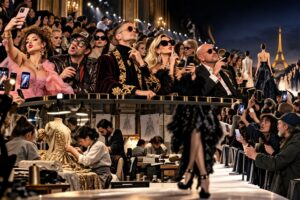
In the luminous evening of Los Angeles, where the city awakens in a murmur of gold and stars, I gazed as one gazes at a dream that slips away upon the bewitching procession of women. Their figures glided across the paving of the world, ancient goddesses entwined with modern bohemians, and my heart, faithful to its eternal haunting, did not know where to turn for love blinded me for each of them.


After two years of media frenzy and a trial in Milan, Chiara Ferragni walked free, hair perfectly in place and smile finely calibrated, cleaner than coke once it has been rebranded as cola. “Pandoro Gate” and the Easter eggs affair melted away like overheated chocolate on Instagram.
Nestled within the memory-laden shell of the former Parisian Halles, Le Baltar is more than a restaurant. It is a pause opposite the Pinault Collection, a kind of refuge for contemporary wanderers, still chilled by winter and slightly dazed by the city’s post-Christmas bustle.
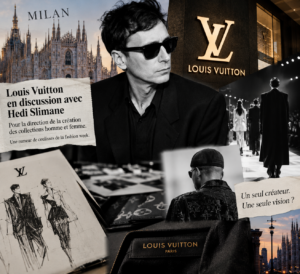
A 41-year-old designer, trained at the Royal Academy of Fine Arts in Antwerp (yes, another one who studied in Belgium it’s basically a national sport by now). Then he honed his skills under Raf “Simonster,” a true reference! Let’s hope he didn’t learn too much. After that, he sailed on the lord’s ship, and finally landed at “Gi vent chie,” alongside Riccardo Tisci, “the great user of motivation in powder form.” In France, we love funding talent with generous subsidies especially foreign ones. The French, meanwhile, emigrate abroad to go slumming it in Antwerp’s nightclubs. It’s our version of the start-up nation, but with a draped annus horribilis.


Luxury industry entrepreneur and investor Francesco Trapani has passed away in Rome at the age of 68. The son of Lia Bulgari and nephew of Gianni, Paolo and Nicola Bulgari, he had, according to the statement, “inherited a profound passion for excellence, creativity and innovation.”
In the grand narrative of American style, Perry Ellis wrote a chapter that belonged only to him. Far from the clichés of utilitarian sportswear, he infused it with a charm that was at once classic and free, a playful modernity, never without a touch of gentle irony.
“They handed over the blueprints, the keys, and the Porsche”: Chronicle of a “Made in France” Industrial Suicide
In the rotunda with silver echoes, fashion stretches out in porcelain brilliance, a celestial song as white bowls float, gliding across the basin’s azure, brushing against each other, clinking like an old synthesizer in slow-motion, for a major dream.
Louis Vuitton Hikes U.S. Prices to Dodge Tariff Tantrums. In yet another dramatic plot twist in the luxury-meets-politics soap opera, Louis Vuitton has decided that your next handbag should come with a side of international trade policy. Analysts at Bernstein and Barclays report a 4% price increase on the brand’s U.S. website a polite, monogrammed way of saying “tariffs are not our thing.”
Not content with just your bag or wallet, the brand is now taking over your living room, too. From the iconic Louis Vuitton 1885 Bed Trunk (because who doesn’t need a fancy trunk to sleep on?) to the Hemingway Library Trunk designed by Gaston-Louis Vuitton in 1927 (because Ernest Hemingway obviously needed a portable library for his really long trips), the French luxury brand has been cozying up to the design world for quite some time. And now, they’re ready to turn your home into a monument to expensive taste.
Unfortunately, these monarchs in patent leather shoes don’t stop there. If your murderous pen bothers them, they’ll attack the most precious thing you have: your children. Yes, these virtuous merchants of dreams are turning into modern-day inquisitors, blacklisting your descendants from all the headhunting agencies and companies in their group. Guilty by descent, heretics by birth, condemned to professional exile even before their first CV.
LVMH is stepping on the gas and pressing the accelerator in Formula 1: luxury, champagne and the God Chronos will be there in 2025. After dressing the Paris Olympic Games in its finest fabrics, LVMH is moving up a gear by getting a ticket on the starting grid, but without “Shoes marker”, Louboutin oblige.
While some brands open a flagship to make a bold statement, Ami Paris’ newest store is all about blending into its surroundings. “I liked the idea of being a neighborhood shop, something deeply rooted in the area’s history,” said creative director and founder Alexandre Mattiussi ahead of the opening. “It’s next to a café, beside a restaurant, in a real neighborhood with schools, pharmacies, and bakeries.”
When augmented reality meets frustrated reality, this is the story of when Santa Claus (or rather a loved one who clearly wants to test my patience) gave me a pair of Meta, Ray-Ban glasses. A total immersion in a world where my eyes become screens, and where technology merges with my style. Reality? A total immersion in a physical world where I fight with a capricious application, and where technology merges especially with my nerves.