
DUPE-LEVEL PRICES
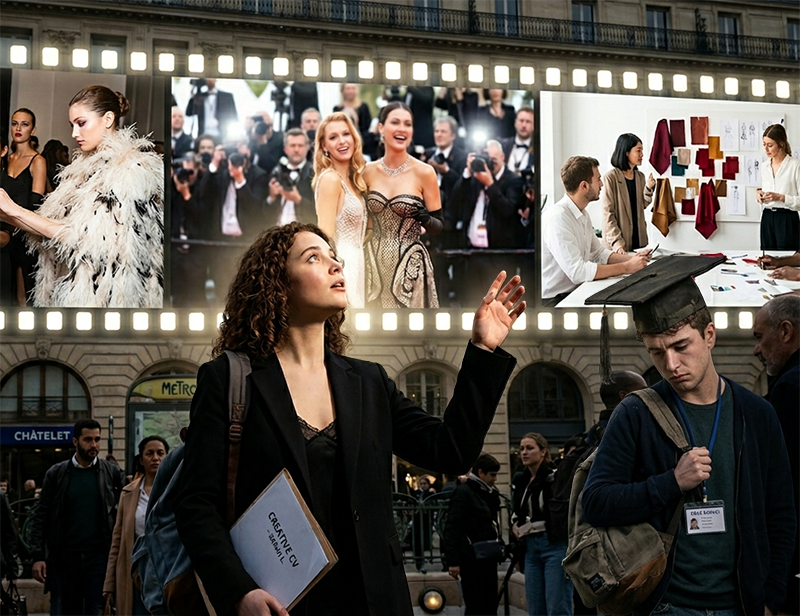 The Ministry of Culture regularly offers support schemes aimed at helping French companies in the fields of couture, leather goods, jewelry, accessories, and watchmaking. On paper, the initiative sounds commendable: encouraging creativity, supporting talent, preserving craftsmanship. But a closer look at the eligibility criteria tells a different story.
We’re told these are “grants,” yet with a minimum turnover of €250,000, it’s no longer a springboard, it’s a trampoline already in orbit. For young designers, the bar isn’t just high… it’s haute couture.
The ANDAM “Pierre Bergé” Prize? A lovely promise… provided you’ve already proven you no longer really need it. A prize to “emerge,” on the condition that you’ve already resurfaced from beneath the desk. A kind of moon mission where you never actually see the sun.
As for the realm of Arnault and the Lady of Châtelet, no official minimum is stated for their prizes dedicated to young designers. Yet in reality, the selected profiles almost always show revenues between €50,000 and €300,000. As the Cashmere Wolf (an expert in textile illusions) puts it: “At LV, there is no minimum… you just have to read with your eyes closed.”
The implicit message becomes hard to ignore: without connections, without resources, without initial capital… fashion is no longer a runway, it’s a password. As Ralf of Toledo (a professional reject) sums it up: “It’s not closed, of course… it’s just reserved for those who already know how to get in,” preferably with a classmate who’s already in the industry.
And yet, if a young designer is already generating €200,000 in revenue, do they truly need this kind of support? When the reward sometimes isn’t even worth as much as a “Speedy” bag, the irony is striking. Deep down, the message is tailor-made: plenty of display, a pretty ribbon… and content quieter than a Capucine clasp.
In the end, these schemes often look more like showcases than real drivers of equal opportunity. A shiny lucky bag, perhaps, but one whose contents feel rather light compared to the effort required to access it.
Another, quieter reality adds to this picture: major fashion houses rarely recruit French couturiers trained in French schools. A paradox in a country that claims to be the cradle of fashion.
Instead of promoting its own talent, the system seems fascinated by international profiles. Young French graduates, trained in institutions recognized by those very houses, struggle to find their place in the ateliers they once dreamed of joining. As if the exotic appeal of a CV now outweighs the proximity of craftsmanship.
The message, once again, is blunt: being trained in France in no way guarantees working there.
So should one persist? Or look elsewhere?
Many end up making a pragmatic choice: leaving. Trying their luck in London, Brussels, or New York, where fashion ecosystems can sometimes be more open, more accessible, or at least clearer in their expectations.
The advice becomes almost ironic: to succeed in French fashion… it may be better not to stay in France. A bitter conclusion, reflecting a sector that celebrates creativity while, in its mechanisms, locking out those who need it most, and above all, those who are true creators.
FM