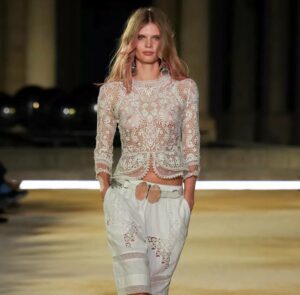
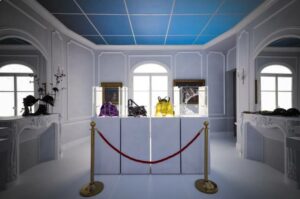
With its brushed steel gleaming like a freshly polished wing, its paddock-style concrete, and its flashes of red leather worthy of a bucket seat ready to take a splash through Eau Rouge, the new Ferrari Lifestyle flagship is clearly no longer a boutique. It’s a permanent qualifying lap.
Set at the corner of Old Bond Street and Piccadilly, it growls like a V12 in the heart of London, drawing a familiar crowd: ecstatic tifosi, Sunday strategists, and experts ready to explain why they would have done better than the pit wall… in couture.
Housed in the former De Beers London jewelry store at 45 Old Bond Street, the space spans 850 square meters across three floors. Three levels, like the three phases of a Grand Prix weekend: practice, qualifying, Sunday chaos. All around, rival luxury “teams” line up — Cartier, Tod’s, Prada, Tiffany & Co. — but here, there’s no safety car to slow things down; it’s flat-out, even in the event of a crash.
Granted, it’s not Ferrari’s first Lifestyle space, but this one shifts up a gear. There’s even an exclusive atelier, a kind of ultra-private pit stop where outfits are fine-tuned like a single-seater before a decisive Q3 run. Continue reading
Hair experimentation has become Cardi’s trademark. At 33, the rapper, actress, entrepreneur, and trophy-wielder parades through a carnival of transformations where gaudy wigs and excessive makeup pass for identity. On red carpets and runways, she flaunts high-impact “looks,” supposedly unfiltered, that thrive above all in a society obsessed with glitter and vulgarity.
At Paris Fashion Week, people usually come to showcase a style. Then there’s Jaden Smith, who seems to have decided to show up… with his housing slung over his shoulder. Yes, the son of Will Smith, now apparently the creative director of “Loubou Catin.”

In the perpetual carousel of creative leadership in fashion, change is almost a house tradition. This time, the shift comes at Etro, where Marco De Vincenzo is stepping down from his role as creative director after several seasons shaping the brand’s aesthetic.
This season, the house of LITKOVSKA appears for the first time on the official calendar of the Paris Fashion Week with its Autumn-Winter 2026/27 collection, FIREFLY. It is born from a fragile, almost nocturnal image: that of a stubborn light that refuses to disappear.
In the vast machinery of luxury, certain details chime like small bells in a silent corridor. At times, a simple moment, almost furtive, can spark a thousand hypotheses. The appearance of looks reminiscent of Rick Owens among the first models in the Louis Vuitton collection designed by Nicolas Ghesquière was, of course, not insignificant to attentive observers.
Parisian fashion possesses a curious talent for social metamorphosis. It often begins in a spirit of almost joyful insolence, a provocation that is vaguely sexual, vaguely artistic, and then, with time, it gently settles into the comfortable districts, where the trees are neatly trimmed and the dogs perfectly vaccinated.
As if the Parisian night had opened a notebook of dreams, Seán McGirr presented his fifth collection for Alexander McQueen not as a simple runway show, but as a strange ceremony of visions.
Perched at the prow of Celine, Michael Rider, who is not the “Cup” but holds the cut, did not summon ghosts nor ask the hangers to whisper the secrets of his predecessors. No séance in the wardrobes. No turning tables between two clothing racks. No. Rider chose the most straightforward liturgy of contemporary fashion: to sell. To sell as one beats time. Wearable, profitable. The Lord will surely be pleased.


The show by Chinese designer Caroline Hu was said to be a striking demonstration of her talent for craftsmanship and storytelling. Striking indeed. Like a cold draft in a couture salon.
The sun, that worldly critic of Parisian high society, had decided to attend the show. It blazed with the insolence of a poorly aimed spotlight, turning the Tuileries Garden into an incandescent tearoom borrowed from Piton de la Fournaise. The traditional tent had vanished, exiled like an idea deemed too timid. In its place stood a mirrored architecture, delicate as a mischievous jewel, encircling a small octagonal lake. A runway hovered above the water, suspended between sky and reflection. My neighbor leaned over and whispered, “It’s the fashion duck pond.”


To celebrate twenty years of his career, Erdem Moralıoğlu unveiled a collision of genres so extravagantly theatrical one might have sworn Madame de Pompadour was flirting with a punk in a post industrial club beneath a Bohemian crystal disco ball. In a world where the economy feels like a corset laced too tight, his devotion to couture borders on romantic heroism. London, ever eager to applaud its prodigies, watched him as one watches an alchemist turn anxiety into embroidery.
Remember the 19th-century rentiers… those legendary creatures who invented the revolutionary concept of “doing nothing and being adored for it.” They lived off their rents like dragons on their gold, got up at noon, ate with the air of a Greek tragedy, and wondered why the world didn’t admire them enough. Society, they claimed, was “unjust”… especially for those who actually had to work.
There are, in the history of fashion, figures who sculpt time like marble sculptors, and others who sculpt above all their own legend, the way one sculpts the mushroom of a Nymph. Maria Grazia Chiuri undoubtedly belongs to this latter category, that iconoclastic brotherhood that confuses communication with creation and the slogan with vision.
After three years of absence, and a final article that had the effect of a monsoon in a spit on his career, the designer decided it was time to return to the catwalks. London, soaked to the bone, provided the perfect backdrop for this climatic miracle: Macdonald, the messiah of polyester, came to bring the sun, but what we saw was an eclipse.
Foday Dumbuya’s latest “collection” was a public trial of the abysmal mediocrity of contemporary fashion, closer to a declaration of war than to a runway show. So-called traditional catwalks emerge from dusty altars of déjà-vu, and seemed to burn under the impact of this textile barrage, as if originality had returned to reclaim its territory through bursts of color and memory.
Each season, there is a collection that brutally reminds us why the great houses exist. This season in London, it was this one. Designer Phobe English, emancipated from a major atelier, delivered a collection she describes as “an illustration of the beauty of plants in full bloom” and “a bit of magic”. Illustration is indeed the right word. Fashion, much less so.
Her name is Dua Lipa: “Dua” means “love” in Albanian, and “Lipa” is her surname, of Kosovo-Albanian origin. Having fled the Yugoslav Wars for London, Lipa has long spun a success story of exile and resilience.
Dennis Basso embodies this almost timeless figure of American luxury, a designer who built his legend on fur, a material both spectacular and deeply controversial. His rise, sealed in the 1980s by the endorsement of New York’s elites, tells as much the story of fashion as it does that of a particular relationship to power, prestige, and social visibility.