ARMANI L’ÉCLAT DES ANNÉES PERDUES


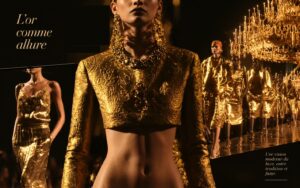
Valentino Garavani passed away last Monday, in the hushed silence of his Roman residence, at an age when life already resembles a legend. Chic. “A short word, a vast kingdom.” This phrase, spoken during the filming of The Last Emperor, became the chronicle of his final fashion show in 2008 and illuminates the man in his entirety.
When he founded his house in 1959, the world was not yet ready to receive his name as an emblem. But the decades, patient gardeners of fame, did their work. By the late 1970s, and then with greater brilliance throughout the 1980s, Valentino became one of the fixed stars around which the Italian renaissance revolved. Alongside Armani, Versace, Ferré, and Missoni, he gave Italy a new voice, firm and sensual, capable of rivaling the ancient capitals of taste.
Some sought to reduce his art to a few visible signs, the evening gown as a whispered confidence, but this would be to forget what mattered most. What ran through all his work, like an inner light, was beauty itself, joined with elegance, and that singular red, a color not of blood but of destiny.
One day in 1968, history leaned toward him. Jackie Kennedy, already a figure inscribed in the memory of the world, chose for her marriage to Aristotle Onassis an ivory dress fashioned by his hands. This gesture, discreet in appearance, suddenly widened the horizon of his name, as if a door had opened onto the universal. Continue reading
“I have the impression of being the guardian of the Zegna family wardrobe,” Alessandro Sartori remarked, and in that single sentence he opened a gallery of memories whose walls seemed lined with ancient linens, imbued with repeated gestures and respectful silences. A guardian, not in the sense of watching over a motionless treasure, but rather of tending a fire passed from hand to hand, its flame changing shape without ever being extinguished.
The models emerged from the dressing room as one steps out of a mental wardrobe, the place where lived seasons are stacked one upon another. Beneath their feet, the floor became a patchwork, strewn with rugs of uneven sizes, varied motifs and styles, mirroring those memories that never quite arrange themselves into order. The bodies, young or mature, drawn from diverse geographies, and at times even female, formed a long, nuanced sentence, in which each silhouette added a new inflection to Sartori’s discourse. There was nothing uniform here. Everything belonged to a subtle harmony.
For Sartori, the irreproachable quality of his work is not an austere dogma. It resembles instead an intimate, almost domestic ethic, one that urges repair rather than disposal, adjustment rather than replacement. The classics of the Zegna wardrobe are not quoted as relics, but reread, shifted, gently corrected by the present. Continue reading
FM: You say “unlock the invisible.” What exactly do you mean by that?
Odile Laganier:
I mean what silently holds you back. It’s not necessarily dramatic. These are habits, family loyalties, inherited beliefs, protective mechanisms, unspoken things, fears, sometimes just a poor wiring with the world. Most people think they have a strategy problem. In reality, they have an unresolved inner conflict. You can’t truly steer your life if a part of you is still in survival mode.
FM: Many of your clients are “successful” on paper. Why do they still come to see you?
Odile Laganier:
Because external success doesn’t replace inner peace. You can tick all the boxes but not truly inhabit your life. You can be applauded but not aligned. You can be on the right path but not have the right energy. And when it shows, it’s too late. When it’s felt, that’s the right time to intervene.
FM: Concretely, how do you work? Continue reading
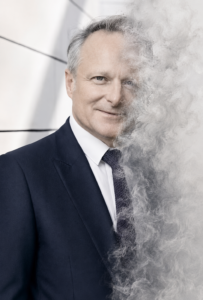
Beneath the dome of the Institut de France in Paris, a new chapter opened this week for the luxury titan, a familiar silhouette with international stature, stepping onto the green carpet.
On Monday, January 12, 2026, he was formally installed as a member of the Académie des sciences morales et politiques, within the section of Political Economy, Statistics and Finance, taking up the prestigious seat number one left vacant by Denis Kessler, former chairman of the reinsurance group Scor, who passed away in June 2023.
This was no mere social formality. One of the five learned institutions of the Institut de France, the Academy brings together fifty figures elected by their peers for their contributions to the nation’s intellectual, political, and social life since its founding in the nineteenth century. Yet for the lord, it always remains a matter of money.

At the Lord’s house, talent management is a delicate art, akin to rotating bottles of grand cru. At LVMH, one does not speak of “internal mobility”. That would be vulgar. Instead, one prefers a “trajectory”, a “journey”, even an “HR odyssey”, complete with Manhattan views, champagne on ice, and a perfectly pressed CV. On Tuesday, the luxury giant announced three top-level HR appointments. Three promotions, three emotional continents, and one certainty. At LVMH, talent does not stagnate. It travels first class.
Paula Fallowfield, from vineyard to skyscraper, is appointed Chief Human Resources Officer of LVMH Americas as of April 1st. No, this is not an April Fool’s joke. Based in New York, she will report to Maud Alvarez-Pereyre, the group’s high priestess of HR, and work hand in hand with Michael Burke. In other words, Paula is arriving where decisions are made fast, very fast, somewhere between two meetings and an oat-milk-dollar latte.
A discreet chime has echoed through the hushed corridors of Givenchy. As of this Friday, the house hands over its keys to Amandine Ohayon, a seasoned figure in fashion and beauty, stepping into the role as one might enter an impeccably ordered drawing room, mindful not to leave ambitions lying about.
Her arrival sets off a gentle game of musical chairs at cousin house Dior. Alessandro Valenti, until now the captain of the Givenchy ship, folds his charts and crosses the inner courtyard to Christian Dior Couture, where he will serve as second-in-command overseeing the hard currency of commerce. A strategic post, to be sure, though one that carries the faint air of a gilded sideline.
Ohayon will report to Pietro Beccari, recently anointed grand orchestrator of LVMH’s fashion division, already stacking titles the way others collect medals. Around him revolves an empire of names that gleam like ancestral coats of arms: Fendi, Celine, Loewe, Kenzo, Marc Jacobs, Pucci, Patou. The table is long, and the seats are dearly priced. Continue reading
I remain deeply astonished, and at times even hurt, to encounter people who have known me for more than fifty years and who, suddenly, seem to be discovering me anew by questioning my abilities. For a long time, I wondered why such doubt emerged so late, like suspicion out of season. Gradually, the answer made itself clear.
This doubt does not speak about me. It speaks about them. To acknowledge today who I have become, or perhaps who I have always been, would force them to reconsider their own judgments. Yet some stubbornly refuse to revisit their past certainties. To step back would be to accept, when facing the mirror, that they were wrong, sometimes gravely so. That they judged too quickly. That they confused self confidence with superiority. It is true, after all, that the path of ignorance is paved with fine editions.
At the time, they believed themselves at the top, and from that comfortable vertical position, others could only be below. To admit today the worth of those they once looked down upon would mean cracking that old inner structure. So they choose doubt, minimization, and questioning of what nevertheless asserts itself with clarity. Continue reading
London is set to reconnect with the buzz of the runways this February, as it hosts a new edition of its Fashion Week, whose schedule promises to be both dense and highly symbolic. Between long-awaited returns and emotionally charged farewells, the British capital will unveil the Autumn Winter 2025/26 collections over nearly a week of creative encounters.
Running from Thursday 19 to Monday 23 February, the event will feature a total of 46 physical runway shows, complemented by 15 presentations. The final day will also spotlight digital creativity, with 19 online projects led by a new generation of designers.
The season will open with Paul Costelloe, presenting a collection conceived before the passing of its founder. A respected figure in Irish and British fashion, and once closely associated with Princess Diana, the designer passed away last November at the age of 80. The show will serve as a discreet yet solemn tribute. Continue reading
For nearly twenty years, Kim Jones did not merely design clothes. He embodied a central figure of globalized creative capitalism, an ecosystem in which individual talent becomes a strategic resource, exploited at an industrial pace. His exemplary career within LVMH tells less the story of a personal success than that of a cultural production model built on intensity, permanent mobility, and the fusion of creative identity with economic machinery.
The designer’s confession, when he speaks of time as a luxury that has become scarce, acts as a revealing moment. It highlights a structural tension within contemporary fashion: the higher one rises in the symbolic hierarchy, the less control one has over one’s own time. The star artistic director is not a free artist, but a logistical node, caught in a relentless rhythm of shows, travel, overlapping collections, and brand narratives that must be constantly renewed. The early exhilaration gradually turns into existential fatigue, not from a lack of recognition, but from an excess of demands.
Femininity is not measured in trophies or calendars. It moves. It thinks. It remembers. It advances like an inner sentence that nothing truly interrupts.
It lives in the slow gestures of morning, when light brushes a shoulder still bare of dreams. It stands in the silent room where a woman, before even naming herself, already exists. Not as a role, but as a presence. A consciousness in motion.
Femininity is an ongoing conversation between body and mind. It knows the patience of fabrics, the memory of hands, the quiet strength of those who learned to stand without noise. It has no need to be proclaimed. It is sensed in the tilt of a gaze, in the calm certainty of those who know who they are, even when the world looks away.
It is plural, shifting, elusive. At times as solemn as a winter sea, at others as laughing as a summer without promises. It does not obey official seasons. It invents its own time. It moves through salons and streets, radiant gatherings and inner retreats, always accompanied by that private thought that whispers: I am here. Continue reading
Antony Price, the flamboyant designer whose iconic silhouettes dressed members of Roxy Music, Duran Duran and even Queen Camilla, passed away on Wednesday at the age of 80.
He made his final public appearance last month at a much-acclaimed fashion show presenting his one-off collaboration with Marco Capaldo for 16Arlington. A final bow, luminous and true to his singular elegance.
The fashion world is deeply saddened by the loss of Antony Price. He was not only an exceptional designer, but also a dear friend, whose generosity of spirit, wisdom and warmth profoundly touched all who had the privilege of knowing him.
Antony Price was not simply a designer. He reigned. A discreet king in the kingdom of fashion. His genius, technical mastery and vision were unmatched. It is heartbreaking to reflect that his immense talent was not always recognised, during his lifetime, with the acclaim it so richly deserved. Continue reading
Pieter Mulier moves through fashion the way some men move through life, with the anxious elegance of those who know destiny enjoys changing its mind at the last moment. As artistic director at Alaïa, he has put breath back into a house once thought frozen, as one might crack open a window in a room admired too long in silence. Since 2021, something has begun to beat again at Alaïa, and Richemont, not exactly known for sentimentality, has grown attached. One does not easily let go of a man who reminds you that clothing can still have a soul.
And yet Milan is calling. Versace, that house which has always lived too loudly to die quietly, is looking for its future in an old mirror. Mulier’s name is spoken the way a possible love is spoken of, never made official, always feared. Nothing is signed, everything is negotiated, and in this hesitation lies a very novelistic truth: fashion, too, is afraid of making a mistake. Continue reading
We live in a marvelous age: everyone is a specialist in everything, provided they have never practiced anything. Knowledge is deemed suspicious, experience arrogant, and competence downright indecent. Today, it is enough to speak in order to exist, and better still: to speak badly, and above all, at great length. Opinion has become a career, and ignorance a posture.
And so China, that country once thought to have little taste for fantasy, has just committed the ultimate breach of etiquette: asking for competence from those who speak about subjects they do not know. Yes, competence. Degrees, knowledge, a craft, the absolute horror in a modern era where opinions are worn like baseball caps and legitimacy is downloaded with a filter.
Thus, as of October 25, 2025, self-proclaimed prophets, experts born between two stories, specialists in everything and masters of nothing, whose only qualification is having spoken louder than others, would be banned from China. In short, China dared to remind us that seriousness is not a weekend hobby.
Rocco Iannone works at Ferrari Style like he tends to a legendary engine. As creative director, he designs the collections, orchestrates the silhouettes, and adjusts the accessories with the precision of a skill honed on rare machines. Before Maranello, he honed his skills at houses with solid traditions: Giorgio Armani, Pal Zileri, Dolce & Gabbana schools where elegance is measured down to the millimeter and over time. Continue reading
It all began one Saturday on an elegant street in Belgravia. Motcomb Street was then home to only one Jimmy Choo boutique, the tiny epicenter of a still-young brand. Hannah Colman sold shoes there on weekends, never imagining that this hushed space would become the starting point of a decades-long story.
Her Saturday shifts gradually transformed into a daily responsibility. She learned about the brand through hands-on experience, by listening, by the customers who came in, hesitated, and returned. The boutique became her laboratory. When she took over as manager, she already knew every detail, every expectation, every silent promise contained within a pair of shoes.
The years passed, and the scope expanded. From London storefronts to international markets, Hannah Colman nurtured the brand’s growth as one would nurture a living being. She climbed the organizational chart, took charge of entire territories, and then global e-commerce, all while retaining that invaluable, hands-on knowledge that cannot be taught. Following Pierre Denis’ departure, she oversaw the transition and, in 2020, took the reins of the company permanently.
Consumers still believe they are choosing. They manipulate images of themselves, virtually try on a lipstick or a hairstyle, and call this freedom. In reality, the machine is already watching, already learning, already sorting.
What is coming is not a simple refinement of these digital amusements. Soon, the system will no longer merely suggest a mascara or a cream. It will buy them. Not with your informed consent, but with your silence. Choice will become a useless formality, like voting for a single list.
This is called agentic AI. The term is new; the idea is old. Artificial entities, endowed with autonomy, pursue an assigned objective without asking how or why. They do not wait for precise orders. They interpret. They act.
Earlier artificial intelligence responded when questioned. The new one acts before the question is even formed. It does not converse; it executes. It coordinates with other agents, invisible, silent, efficient. A network without a face, in which each element works for the whole. Continue reading
Salt & Stone has emerged as one of the most dynamic players in the body-care market by turning an everyday product into a major commercial success. The California-based brand has built a business valued at 140 million dollars thanks to a flagship deodorant that has become a top seller on both Amazon and Sephora.
Its growth relies on three strategic pillars. First, a careful focus on fragrance, designed to stand out in a segment long dominated by standardized formulas. Second, a clean, deliberate aesthetic that places the product firmly within the premium wellness space. Third, a pricing strategy calibrated to reach a broad audience while preserving an upscale image. Continue reading
On that winter evening, when December 5th spread its cloak of cold mist over Paris, an unexpected marvel rose from the banks of the Seine. There, above La Seine Musicale, three thousand seven hundred obedient lights, like stars born of human hands, scattered across the horizon like dust from the firmament.
These drones, mechanical spirits still warm from the breath of the workshops, took on in the sky the majesty of ancient constellations. In the silence of the heights, they traced immense visions of flame and ash, as if some fallen deity had entrusted to the winds the fragments of a vanished world. Continue reading

Rumor has it that the Prince of Medici snatched the position from LVMH for the presidency of the Comité Colbert with the same ease he grabs a “Money paint ” at a private sale: silently, but leaving everyone stunned.
In the end, it is Hélène Poulit-Duquesne, CEO of Boucheron (Kering group), who will officially inherit the throne in June. A board member since 2018 and vice president since 2022, she secures the crown as if it were the most natural thing in the world and without even a Gucci gown.
As for Bénédicte Epinay, CEO of the Comité Colbert, she said she looked forward to working with the newly elected chairwoman in order to “strengthen the influence of a sector whose excellence and creativity make it one of the flagships of the French economy.” A remarkably enthusiastic statement which makes sense, since she clearly intends to keep her job.
On the LVMH side, insiders whisper that if they weren’t offered the presidency, it’s simply because their ability to embody French luxury has no need for a title. What’s the point of a token seat when you already own the Empire? A touching modesty, reminding us that in the shadows of plush salons, the real kings don’t fight for crowns… they collect them.