These are not the “Mercier” bicycles. In the ordered world of luxury and French music, where days unfold with the precision of a Swiss chronometer, and where every gesture seems like a genetic blending of Mozart and the DNA of a metronome, a dissonance may nevertheless appear. For a single foreign note is enough to disturb the harmony of a musical salon that seemed too perfect.
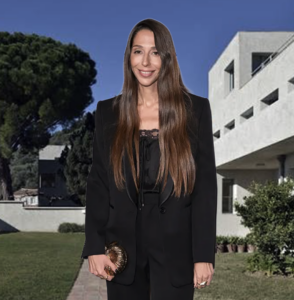
Perhaps that is what is happening today around Hélène Mercier. A renowned pianist, a woman of quiet distinction, the wife of a great lord of industry, she belongs to that hushed universe where grace merges with restraint, where half-tones are preferred to tumult and music to rumor. And yet, through some caprice of the media’s fate, her name has brushed against an unexpected affair. In the almost complicit silence of the fashion press, this enigma floats like a question without an answer.
Now, appearing where no one expected him, comes the name of Gims. A popular artist, a voice familiar to immense crowds, he belongs to another sonic kingdom, that of chanted refrains and illuminated stages. His appearance in the tranquil shadow of a Chopin-like world resembles those improbable encounters our era seems to relish.
Hermès is reportedly preparing to welcome French designer Léa Peckre, at a time when the house has been hinting at a possible move into haute couture. The details of her role and her starting date have not yet been specified, but she is expected to work under Nadège Vanhée, artistic director of Hermès women’s ready-to-wear since 2014.
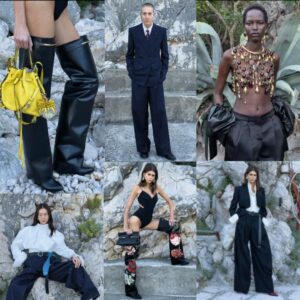
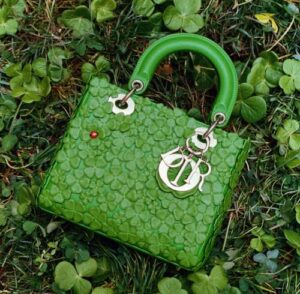
One day, the Mont-Saint-Michel was bound to meet its fool. For thirteen centuries the rock has watched pilgrims, kings, armies, and tides capable of swallowing entire regiments. Yet it was still missing a rarer apparition: the little advertising strategist convinced that a thousand-year-old monument is nothing more than a backdrop for a miniature handbag.
Alice Taglioni, a silhouette with two faces, the one before and the one after, now stands beneath the spotlights of the Series Mania Festival in Lille. Here is how the struggle of appearances comes together to shape the world. Allow yourself to be carried into a theatre where elegance whispers, yet invisible storms rumble beneath the surface.
In the vast tapestry of fashion, where threads of gold intertwine with destiny and legacy, there emerges a quiet yet resolute heroine:
You recognize Bella Hadid as she arrives at a party on this fashion planet where even black holes have a dress code.
Vestiaire Collective is strengthening its tech division with two strategic appointments, as its new chief executive officer, Bernard Osta, aims to accelerate innovation and move the luxury resale platform closer to profitability.
With its brushed steel gleaming like a freshly polished wing, its paddock-style concrete, and its flashes of red leather worthy of a bucket seat ready to take a splash through Eau Rouge, the new Ferrari Lifestyle flagship is clearly no longer a boutique. It’s a permanent qualifying lap.
Hair experimentation has become Cardi’s trademark. At 33, the rapper, actress, entrepreneur, and trophy-wielder parades through a carnival of transformations where gaudy wigs and excessive makeup pass for identity. On red carpets and runways, she flaunts high-impact “looks,” supposedly unfiltered, that thrive above all in a society obsessed with glitter and vulgarity.
At Paris Fashion Week, people usually come to showcase a style. Then there’s Jaden Smith, who seems to have decided to show up… with his housing slung over his shoulder. Yes, the son of Will Smith, now apparently the creative director of “Loubou Catin.”

In the perpetual carousel of creative leadership in fashion, change is almost a house tradition. This time, the shift comes at Etro, where Marco De Vincenzo is stepping down from his role as creative director after several seasons shaping the brand’s aesthetic.
This season, the house of LITKOVSKA appears for the first time on the official calendar of the Paris Fashion Week with its Autumn-Winter 2026/27 collection, FIREFLY. It is born from a fragile, almost nocturnal image: that of a stubborn light that refuses to disappear.
In the vast machinery of luxury, certain details chime like small bells in a silent corridor. At times, a simple moment, almost furtive, can spark a thousand hypotheses. The appearance of looks reminiscent of Rick Owens among the first models in the Louis Vuitton collection designed by Nicolas Ghesquière was, of course, not insignificant to attentive observers.
Parisian fashion possesses a curious talent for social metamorphosis. It often begins in a spirit of almost joyful insolence, a provocation that is vaguely sexual, vaguely artistic, and then, with time, it gently settles into the comfortable districts, where the trees are neatly trimmed and the dogs perfectly vaccinated.
As if the Parisian night had opened a notebook of dreams, Seán McGirr presented his fifth collection for Alexander McQueen not as a simple runway show, but as a strange ceremony of visions.
Perched at the prow of Celine, Michael Rider, who is not the “Cup” but holds the cut, did not summon ghosts nor ask the hangers to whisper the secrets of his predecessors. No séance in the wardrobes. No turning tables between two clothing racks. No. Rider chose the most straightforward liturgy of contemporary fashion: to sell. To sell as one beats time. Wearable, profitable. The Lord will surely be pleased.


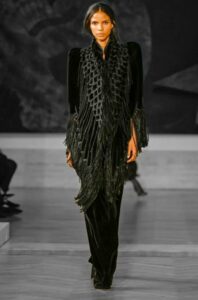
The show by Chinese designer Caroline Hu was said to be a striking demonstration of her talent for craftsmanship and storytelling. Striking indeed. Like a cold draft in a couture salon.