

Alaïa closes one chapter and opens a gilded door onto Milan. Pieter Mulier is preparing to leave the Parisian house to join Versace, under the watchful eye of the Prada Group, now the owner of the Italian label. The official announcement is expected next week, like a curtain rise deliberately delayed.
Tall and slender, with a deliberately understated air, often clad in the now-clichéd uniform of the contemporary designer a long-sleeved white T-shirt Mulier took the reins of Alaïa three years after the death of its founder. Azzedine Alaïa, an obsessive sculptor of the female body, left behind a house both exacting and mythologized, sanctified by an almost monastic vision of the silhouette.
Mulier did not attempt imitation; he chose instead to shift the statue. Onto the Alaïa heritage, he grafted a nervous modernity, at times experimental, always self-aware. A sharpened, emancipated femininity, less devotional and more conceptual, one that never forgot that at Alaïa, the body remains the compass. The result? A house set back in motion, stripped of patrimonial mothballs without sinking into lazy quotation. Continue reading
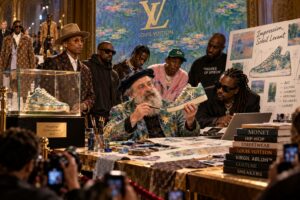
We live in a world in crumbling decay, a world where the Élysée bestows the Legion of Honor upon a minor Pharrell Williams a man once condemned in New York for mistaking homage for a photocopier, plundering Marvin Gaye’s genius. A world where medals are handed out like metro tickets, at the speed of a Shinkansen at full throttle, and now it’s Beckham’s turn, adorned with the Order of Arts and Letters—= she who has never stitched a dress nor sketched anything beyond the arch of an eyebrow. But after Jacquemus, why not?


There are creatures that do not seduce, they warn. Scorpaenids, with their dorsal fins raised like a row of sabres, elegant yet lethal, remind us that beauty is never innocent. A single sting and pain spreads like a narrative poison, invading the body, unsettling the mind, suspending time for hours. Nature here does not whisper, it threatens.
I often think of those solitary souls, too full of isolation, who walk alongside the world the way one follows a riverbank without ever stepping into the water. Without this vice of writing every day, one or two pages or more, without this strange habit that tears me away from the restfulness of ordinary hours, I might perhaps have tasted a simpler happiness, made of shared silences and self-forgetfulness. My pen, always ready to dip itself into the ink of my own reveries, exiles me from an immediate happiness, easy, almost vulgar at times in its obviousness.
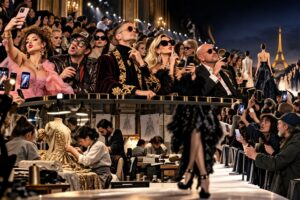
As Véronique Nichanian, the patient and sovereign guardian of Hermès menswear for thirty seven years, prepares to leave the stage, a deep and solemn emotion moves through the evening like a slow ripple beneath vaulted ceilings. What for so long had been an almost monastic appointment at the Palais d’Iéna has shifted, at the hour when daylight withdraws, to the Palais Brongniart, transformed into a vast ceremony of remembrance. There, in the golden half light, gratitude seems suspended in the very air one breathes. It radiates from the assembled faces, from the well known figures who crossed her path, as much as from the unseen artisans who walked beside her in quiet fidelity.
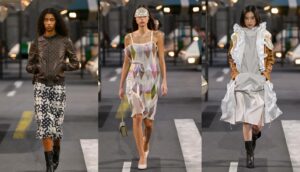
The leather coats, almost stubborn in their rigidity, conveyed a dark and severe impression. Their sharply defined back vents, along with fastenings reminiscent of harnesses, seemed to carry within them the memory of martial discipline, as though these garments had been shaped not only for the body, but for an idea of authority and constraint. They evoked a world in which the individual bends to a greater, impersonal force that no one can ignore.
Seeing certain silhouettes recently emerging from Kim Jones’s ateliers, a question hangs in the air like an overly cold fragrance: does couture still breathe? Draped in a deliberately bloodless aesthetic, these elongated figures with yellowed hair seem less to walk than to float, deprived of weight, of sex, at times even of humanity.
An almost wild fervor and eternal youth seemed to emanate from these aviator jackets, heavy with memories and conquests, and from these bomber jackets where one could sense the soul of skies traversed.
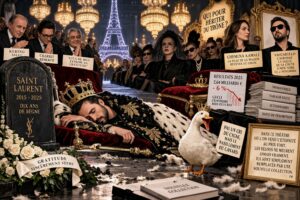
Valentino Garavani passed away last Monday, in the hushed silence of his Roman residence, at an age when life already resembles a legend. Chic. “A short word, a vast kingdom.” This phrase, spoken during the filming of The Last Emperor, became the chronicle of his final fashion show in 2008 and illuminates the man in his entirety.
“I have the impression of being the guardian of the Zegna family wardrobe,” Alessandro Sartori remarked, and in that single sentence he opened a gallery of memories whose walls seemed lined with ancient linens, imbued with repeated gestures and respectful silences. A guardian, not in the sense of watching over a motionless treasure, but rather of tending a fire passed from hand to hand, its flame changing shape without ever being extinguished.
After two years of media frenzy and a trial in Milan, Chiara Ferragni walked free, hair perfectly in place and smile finely calibrated, cleaner than coke once it has been rebranded as cola. “Pandoro Gate” and the Easter eggs affair melted away like overheated chocolate on Instagram.
FM: You say “unlock the invisible.” What exactly do you mean by that?

Beneath the dome of the Institut de France in Paris, a new chapter opened this week for the luxury titan, a familiar silhouette with international stature, stepping onto the green carpet.
At the Lord’s house, talent management is a delicate art, akin to rotating bottles of grand cru. At LVMH, one does not speak of “internal mobility”. That would be vulgar. Instead, one prefers a “trajectory”, a “journey”, even an “HR odyssey”, complete with Manhattan views, champagne on ice, and a perfectly pressed CV. On Tuesday, the luxury giant announced three top-level HR appointments. Three promotions, three emotional continents, and one certainty. At LVMH, talent does not stagnate. It travels first class.
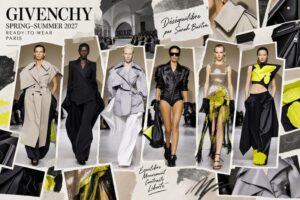
A discreet chime has echoed through the hushed corridors of Givenchy. As of this Friday, the house hands over its keys to Amandine Ohayon, a seasoned figure in fashion and beauty, stepping into the role as one might enter an impeccably ordered drawing room, mindful not to leave ambitions lying about.
Under Joshua Schulman’s leadership, Burberry is repositioning its brand by reframing British luxury as a more universal and commercially legible proposition. The strategy reflects a broader effort to sharpen the house’s identity at a time when luxury consumers are increasingly selective, prioritizing clarity, relevance, and value alignment over abstract brand storytelling.
I remain deeply astonished, and at times even hurt, to encounter people who have known me for more than fifty years and who, suddenly, seem to be discovering me anew by questioning my abilities. For a long time, I wondered why such doubt emerged so late, like suspicion out of season. Gradually, the answer made itself clear.