As Véronique Nichanian, the patient and sovereign guardian of Hermès menswear for thirty seven years, prepares to leave the stage, a deep and solemn emotion moves through the evening like a slow ripple beneath vaulted ceilings. What for so long had been an almost monastic appointment at the Palais d’Iéna has shifted, at the hour when daylight withdraws, to the Palais Brongniart, transformed into a vast ceremony of remembrance. There, in the golden half light, gratitude seems suspended in the very air one breathes. It radiates from the assembled faces, from the well known figures who crossed her path, as much as from the unseen artisans who walked beside her in quiet fidelity.
Outside, on the Place de la Bourse, the crowd chants another name, that of Travis Scott, the sole rap infused contribution to the Hermès fashion narrative, voices hurled into the modern night shaped by the vision of LV. Inside, however, it is Véronique Nichanian’s name that circulates, discreet yet persistent, like an ancient breath threading its way through every conversation. One need only raise one’s eyes to the ceilings to feel the vertigo of a chapter drawing to a close. Later, when the final silhouette has crossed this last runway, the suspended screens will descend slowly, like curtains of memory, restoring yesterday’s salutations. But for now, the artistic director still gathers one final breath and offers it to the Hermès man she has shaped.

The leather coats, almost stubborn in their rigidity, conveyed a dark and severe impression. Their sharply defined back vents, along with fastenings reminiscent of harnesses, seemed to carry within them the memory of martial discipline, as though these garments had been shaped not only for the body, but for an idea of authority and constraint. They evoked a world in which the individual bends to a greater, impersonal force that no one can ignore.
Seeing certain silhouettes recently emerging from Kim Jones’s ateliers, a question hangs in the air like an overly cold fragrance: does couture still breathe? Draped in a deliberately bloodless aesthetic, these elongated figures with yellowed hair seem less to walk than to float, deprived of weight, of sex, at times even of humanity.
An almost wild fervor and eternal youth seemed to emanate from these aviator jackets, heavy with memories and conquests, and from these bomber jackets where one could sense the soul of skies traversed.
Valentino Garavani passed away last Monday, in the hushed silence of his Roman residence, at an age when life already resembles a legend. Chic. “A short word, a vast kingdom.” This phrase, spoken during the filming of The Last Emperor, became the chronicle of his final fashion show in 2008 and illuminates the man in his entirety.
“I have the impression of being the guardian of the Zegna family wardrobe,” Alessandro Sartori remarked, and in that single sentence he opened a gallery of memories whose walls seemed lined with ancient linens, imbued with repeated gestures and respectful silences. A guardian, not in the sense of watching over a motionless treasure, but rather of tending a fire passed from hand to hand, its flame changing shape without ever being extinguished.
After two years of media frenzy and a trial in Milan, Chiara Ferragni walked free, hair perfectly in place and smile finely calibrated, cleaner than coke once it has been rebranded as cola. “Pandoro Gate” and the Easter eggs affair melted away like overheated chocolate on Instagram.
FM: You say “unlock the invisible.” What exactly do you mean by that?

Beneath the dome of the Institut de France in Paris, a new chapter opened this week for the luxury titan, a familiar silhouette with international stature, stepping onto the green carpet.
At the Lord’s house, talent management is a delicate art, akin to rotating bottles of grand cru. At LVMH, one does not speak of “internal mobility”. That would be vulgar. Instead, one prefers a “trajectory”, a “journey”, even an “HR odyssey”, complete with Manhattan views, champagne on ice, and a perfectly pressed CV. On Tuesday, the luxury giant announced three top-level HR appointments. Three promotions, three emotional continents, and one certainty. At LVMH, talent does not stagnate. It travels first class.
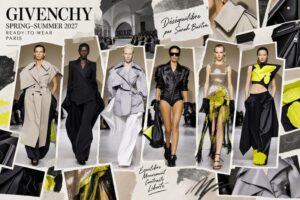
A discreet chime has echoed through the hushed corridors of Givenchy. As of this Friday, the house hands over its keys to Amandine Ohayon, a seasoned figure in fashion and beauty, stepping into the role as one might enter an impeccably ordered drawing room, mindful not to leave ambitions lying about.
Under Joshua Schulman’s leadership, Burberry is repositioning its brand by reframing British luxury as a more universal and commercially legible proposition. The strategy reflects a broader effort to sharpen the house’s identity at a time when luxury consumers are increasingly selective, prioritizing clarity, relevance, and value alignment over abstract brand storytelling.
I remain deeply astonished, and at times even hurt, to encounter people who have known me for more than fifty years and who, suddenly, seem to be discovering me anew by questioning my abilities. For a long time, I wondered why such doubt emerged so late, like suspicion out of season. Gradually, the answer made itself clear.
Nestled within the memory-laden shell of the former Parisian Halles, Le Baltar is more than a restaurant. It is a pause opposite the Pinault Collection, a kind of refuge for contemporary wanderers, still chilled by winter and slightly dazed by the city’s post-Christmas bustle.
London is set to reconnect with the buzz of the runways this February, as it hosts a new edition of its Fashion Week, whose schedule promises to be both dense and highly symbolic. Between long-awaited returns and emotionally charged farewells, the British capital will unveil the Autumn Winter 2025/26 collections over nearly a week of creative encounters.
For nearly twenty years, Kim Jones did not merely design clothes. He embodied a central figure of globalized creative capitalism, an ecosystem in which individual talent becomes a strategic resource, exploited at an industrial pace. His exemplary career within LVMH tells less the story of a personal success than that of a cultural production model built on intensity, permanent mobility, and the fusion of creative identity with economic machinery.
Femininity is not measured in trophies or calendars. It moves. It thinks. It remembers. It advances like an inner sentence that nothing truly interrupts.
Antony Price, the flamboyant designer whose iconic silhouettes dressed members of Roxy Music, Duran Duran and even Queen Camilla, passed away on Wednesday at the age of 80.
Pieter Mulier moves through fashion the way some men move through life, with the anxious elegance of those who know destiny enjoys changing its mind at the last moment. As artistic director at Alaïa, he has put breath back into a house once thought frozen, as one might crack open a window in a room admired too long in silence. Since 2021, something has begun to beat again at Alaïa, and Richemont, not exactly known for sentimentality, has grown attached. One does not easily let go of a man who reminds you that clothing can still have a soul.
We live in a marvelous age: everyone is a specialist in everything, provided they have never practiced anything. Knowledge is deemed suspicious, experience arrogant, and competence downright indecent. Today, it is enough to speak in order to exist, and better still: to speak badly, and above all, at great length. Opinion has become a career, and ignorance a posture.