
WHEN HERITAGE BECOMES PRIVATE PROPERTY
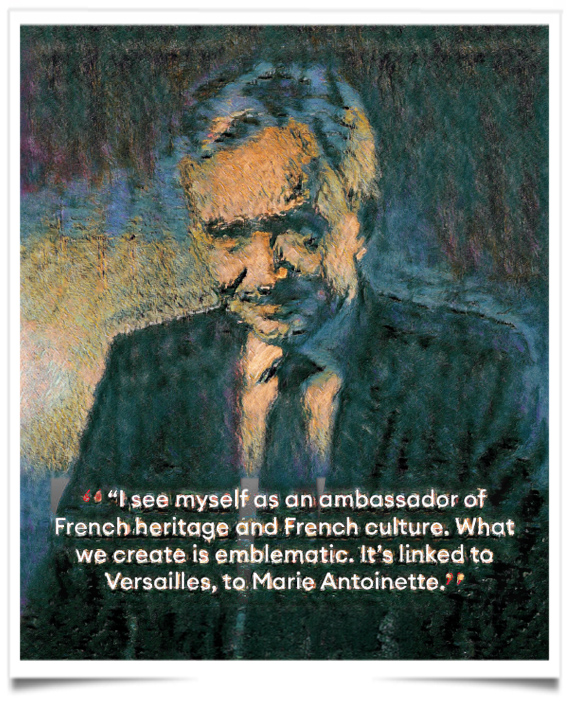 There are sentences that reek of the incense from the bonfire of vanities; these clearly belong to the chapel of industrial ego, where common heritage is mistaken for personal property. Thus, according to the “lord of the rings,” luxury would be nothing less than a sanctuary preserving the “identity,” “history,” and “cultural heritage” of an entire country… A rather spectacular rhetorical pirouette to define the French soul. Surprising, isn’t it?
But since when has France put itself on display in cardboard packaging, tied with logo-stamped ribbon, labeled, and distributed in limited editions across the capitals of the world?
In this statement lies a carefully maintained confusion between heritage and ownership. Alençon lace, the workshops of Grasse, Lorraine crystal—these age-old crafts never needed a conglomerate to exist. They lived before acquisitions, and they will survive divestments. Roots do not grow in quarterly reports for idle shareholders.
Setting oneself up as a transmitter of memory, why not? But claiming the role of France’s official translator comes perilously close to cultural appropriation… on a national scale. As if French identity were a dead language in need of reinterpretation into the dialect of globalized luxury.
The greatest irony, perhaps, lies in this notion of “modern influence.” For in polishing history to make it exportable, one ends up smoothing it until it is sanitized. The narrative becomes a product, heritage becomes positioning, and culture a sales argument among others, wedged between a logo and a margin.
France is not a brand. It is a brilliant cacophony, a theater of ideas, a mille-feuille of contradictions. It cannot be translated; it must be lived, argued over, reinvented—and certainly not licensed. In trying to embody too much, one sometimes ends up revealing a single truth: an ego commensurate with the empire it commands, set against a country far greater than the men who presume to play a role in its collective history.
FM