
GEN Z INDULGENT TOWARD AUTHORITARIANISM
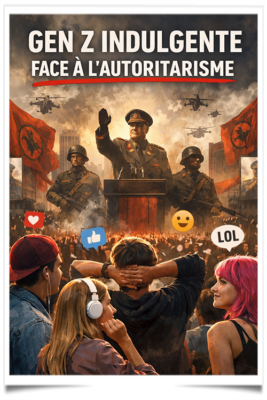 There is, in the spirit of the times, an unexpected fascination with Gen Z. A segment of our younger generations, born into open and democratic societies, now seems to be looking elsewhere, toward authoritarian political models, with a curiosity that can sometimes feel unsettling. China, in particular, has become for some both an object of admiration and a source of questioning.
Behind this attraction lies less a direct rejection of democracy than a diffuse sense of disillusionment. Too much complexity, too much slowness, too many endless debates in the country of human rights. By contrast, authoritarian regimes appear as efficient machines, capable of imposing a clear direction, acting swiftly, building without visible constraint.
It is in this context that a symbolic, almost novelistic figure emerges: Jordan, 28, whom some ironically nickname “the blessed one.” He embodies this generation that does not reject modernity but redefines it. For him, freedom no longer necessarily comes through debate or pluralism, but through access, fluidity, consumption. An ordered, connected world, where everything functions in a simpler, binary way, that is his promise.
As American culture gradually dries up, China regenerates itself by drawing on a massive flow of information relayed through networks, while appropriating the influence of European luxury. Yet this vision rests on a dizzying paradox: can one accept a form of political constraint in exchange for technological comfort? Can one live under surveillance while feeling free thanks to a glowing screen held in the hand? Can one still live in a world where the rich grow ever richer, while a semblance of luxury is imposed on middle classes that grow poorer day by day? It is no longer so much about owning as about creating the illusion of owning. Luxury then becomes a social language, a staging, sometimes a compensation for a perceived downward mobility.
The smartphone also becomes a powerful symbol here, almost a “second brain.” It organizes, guides, entertains, reassures. It gradually replaces critical effort with intuitive navigation. Some see it as an extension of the self, others as a gentle form of guardianship.
The expression “Orwell’s anatomical brain” then evokes a deeper transformation: that of the individual himself. No longer a citizen engaged in a polity, but a user, optimized, adapted, integrated into a broader system. A mental anatomy reshaped by digital flows, where freedom becomes a subjective experience rather than a political reality.
This movement, still diffuse, is gaining ground in France as elsewhere. It is not a sudden shift, but a drift, almost imperceptible. A silent reassessment of priorities: efficiency over freedom, stability over uncertainty.
One essential question remains, suspended like a contemporary riddle: what if this fascination is not a desire for dictatorship, but simply a fatigue with democratic complexity? In that case, the challenge is not only political, it is deeply cultural. To restore meaning to freedom, not as a burden, but as a living richness, before the comfort of order quietly becomes the new norm.
FM