
MARGIELA DOCKS IN SHANGHAI
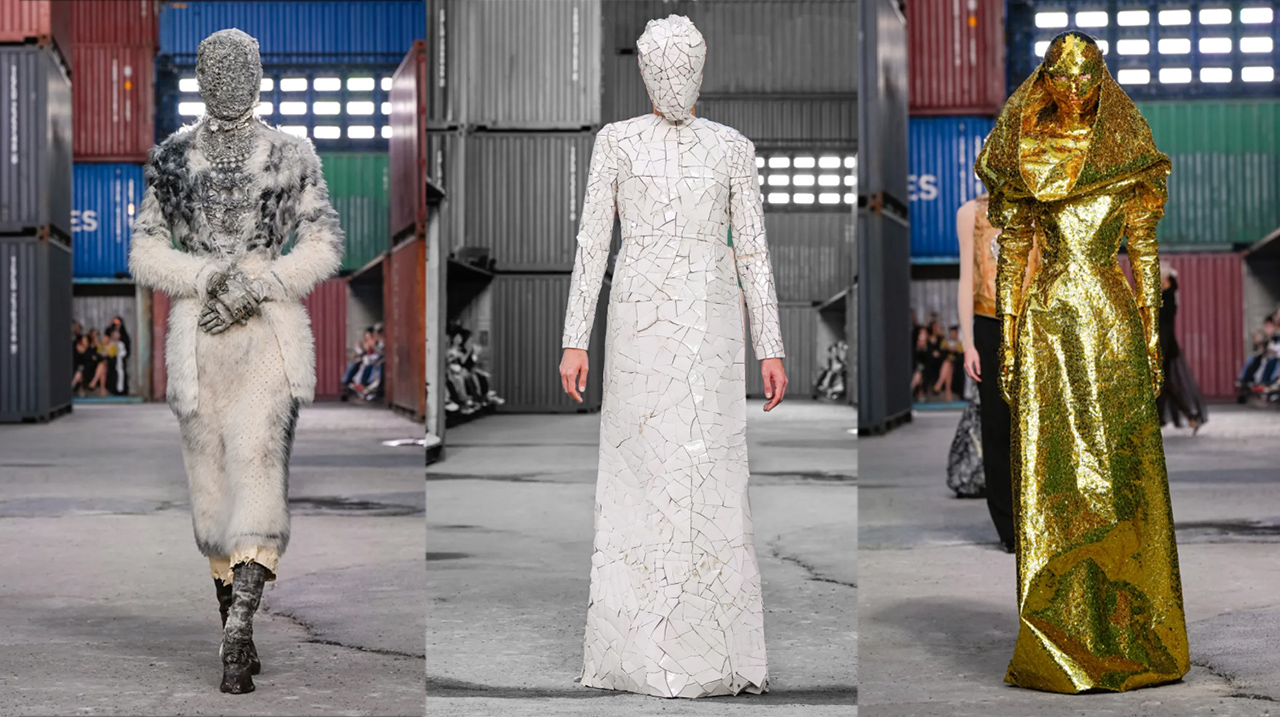 In ports where the sea resembles a sheet of polished steel, containers rise in stacks like giant ideograms. Blocks of orange, blue and rust form a kind of industrial calligraphy that contemporary China writes across the oceans. It is within this landscape of global trade that Maison Margiela chose to stage its Fall 2026 show in Shanghai. A setting of docks and metal boxes, raw and monumental, as if the poetry of luxury had decided to converse with the machinery of world commerce.
Containers as modern cathedrals
These containers, symbols of the endless circulation of objects, become architecture here. They remind us that China, millennial in culture yet vertiginously modern in its ports, is now one of the great orchestras of global commerce. The stacks of metal draw an almost abstract scenery, a temporary city made of perfect volumes. Within this geometry, fashion finds an unexpected stage: a theater where the dress meets the mechanics of the world.
Glenn Martens, the brand’s creative director, chose to embrace this contrast. The show brought together both ready-to-wear and artisanal pieces, echoing the spirit of Margiela’s early years. Some silhouettes evoked Edwardian England, others felt like contemporary sculpture. Extreme draping, deconstructed tailoring, porcelain details. Tradition and experimentation moved side by side, as if history itself were walking along the docks of Shanghai dressed in couture.
A wearable dress amid plastic and steel
Within this industrial universe, the garments seemed to hover between two worlds. Plastic, metal and dockside light gave the fabrics an almost liquid presence. Margiela’s idea of the wearable dress was redefined here through contact with an industrial aesthetic emerging from Asia.
China was not merely a backdrop. It became a material. The ports, the cargo, the maritime routes. All the invisible networks linking continents seemed to condense inside those containers stacked like minimalist temples.
Shoes as illusions
The narrative also unfolded through footwear, a territory where Margiela cultivates strangeness with the curiosity of an alchemist. The Level Cut-Out boots revealed a layer of leather lining, exposing the hidden architecture of the shoe. Some ankle boots had their fronts completely removed, leaving the foot visible to the toes while a cuff of leather remained around the ankle. Others rose to the knee with cut-out windows placed across the bridge of the foot.
Brushed leather, patent finishes and distressed textures appeared throughout. White pumps painted in the brand’s bianchetto style looked as if they had been dipped into correction fluid. Heel-less cowboy boots seemed to defy gravity, floating through the dockside air.
Meanwhile, Perspex-heel sandals played with transparency through clear straps, while the house’s iconic Tabi toe, split like a cloven hoof, returned on the runway in second-skin ballerinas and claw-like boots perched on stiletto heels.
Shanghai between memory and future
Ultimately, the show felt like a dialogue between two eras. The millennial China of deep history and the China of automated ports where millions of containers circulate across the planet. Margiela slipped between these two temporalities like a visual translator.
Some silhouettes appeared to emerge from a historical dream, yet they walked along a quay saturated with metal and plastic. A stage where fashion was no longer only clothing, but landscape.
And within that landscape, the containers themselves became monuments. Industrial pagodas. Blocks of global trade that, for the duration of a fashion show, turned into poetry.