
MULIER: FROM PARIS TO MILAN, A SHIFT IN DESIRE
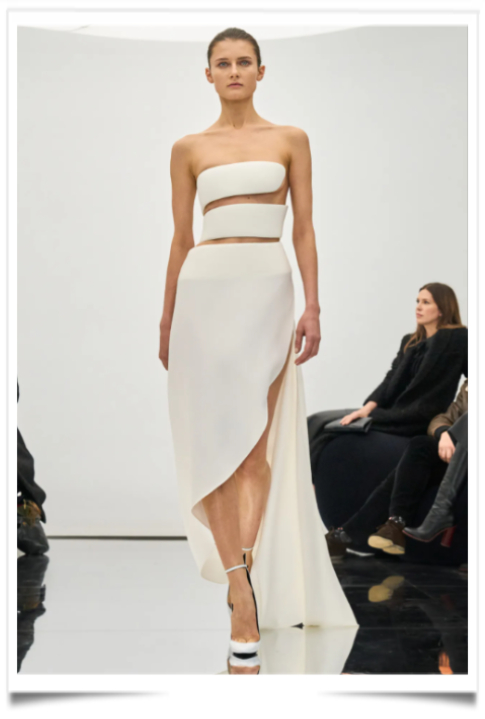 Alaïa closes one chapter and opens a gilded door onto Milan. Pieter Mulier is preparing to leave the Parisian house to join Versace, under the watchful eye of the Prada Group, now the owner of the Italian label. The official announcement is expected next week, like a curtain rise deliberately delayed.
Tall and slender, with a deliberately understated air, often clad in the now-clichéd uniform of the contemporary designer a long-sleeved white T-shirt Mulier took the reins of Alaïa three years after the death of its founder. Azzedine Alaïa, an obsessive sculptor of the female body, left behind a house both exacting and mythologized, sanctified by an almost monastic vision of the silhouette.
Mulier did not attempt imitation; he chose instead to shift the statue. Onto the Alaïa heritage, he grafted a nervous modernity, at times experimental, always self-aware. A sharpened, emancipated femininity, less devotional and more conceptual, one that never forgot that at Alaïa, the body remains the compass. The result? A house set back in motion, stripped of patrimonial mothballs without sinking into lazy quotation.
Meanwhile, the economic engine began to purr with distinctly Swiss efficiency. The distribution network nearly quadrupled to reach twenty boutiques, while accessories asserted themselves as the discreet yet solid nerve of the operation. The mesh ballet flats, launched with Mulier’s very first Alaïa collection, became a global fetish. The elongated and clever Teckel bag found its way onto informed shoulders, soon joined by Le Click, the latest wink in a carefully sustained strategy of desirability.
The Richemont Group, owner of Alaïa, cultivates secrecy around its figures as a cardinal virtue. Yet behind the scenes, it is whispered that the house has more than doubled in size under Mulier’s tenure. Growth fueled as well by a keen sense of staging: off-calendar shows, locations chosen with parsimony, from the Antwerp penthouse to the Rue de Marignan boutique in Paris, all the way to New York’s Guggenheim, with a taste for counter-rhythm, an elegance of indiscipline, and a distinct disdain for the cute.
Pieter Mulier’s departure leaves Alaïa at a pivotal moment: consolidated, desirable, yet once again orphaned. As for Versace, it is preparing to welcome a designer who understands that the body is never an argument, but a conviction. It is now up to Milan to decide whether to sculpt, exaggerate, or cut.
FM