 “I have the impression of being the guardian of the Zegna family wardrobe,” Alessandro Sartori remarked, and in that single sentence he opened a gallery of memories whose walls seemed lined with ancient linens, imbued with repeated gestures and respectful silences. A guardian, not in the sense of watching over a motionless treasure, but rather of tending a fire passed from hand to hand, its flame changing shape without ever being extinguished.
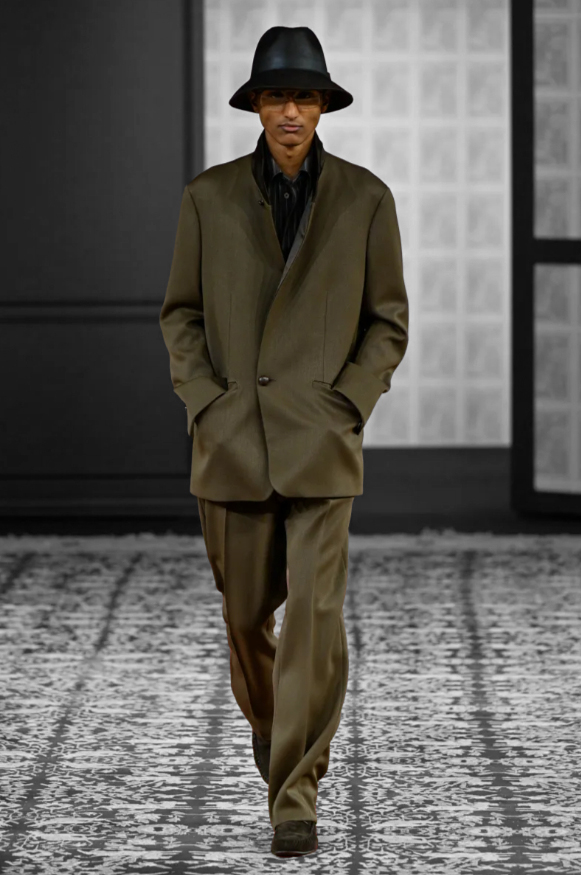
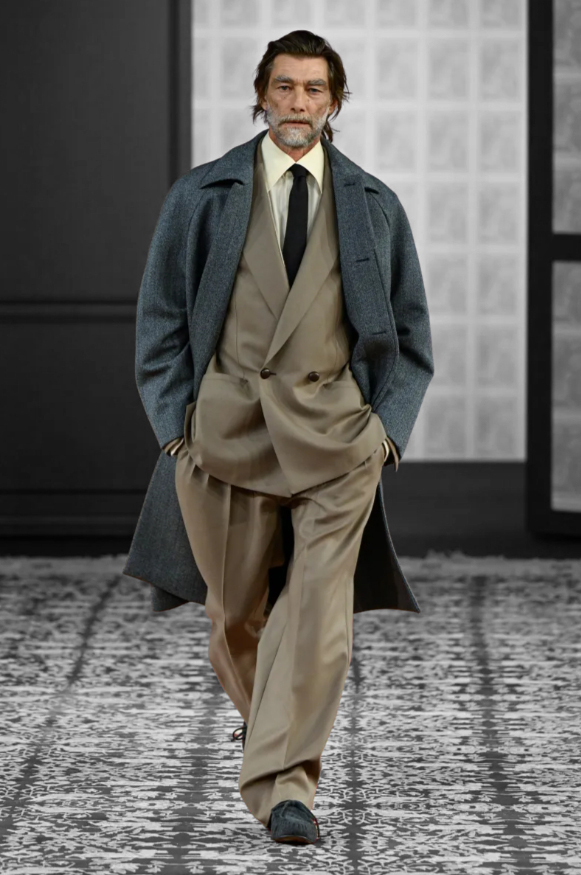
The models emerged from the dressing room as one steps out of a mental wardrobe, the place where lived seasons are stacked one upon another. Beneath their feet, the floor became a patchwork, strewn with rugs of uneven sizes, varied motifs and styles, mirroring those memories that never quite arrange themselves into order. The bodies, young or mature, drawn from diverse geographies, and at times even female, formed a long, nuanced sentence, in which each silhouette added a new inflection to Sartori’s discourse. There was nothing uniform here. Everything belonged to a subtle harmony.
For Sartori, the irreproachable quality of his work is not an austere dogma. It resembles instead an intimate, almost domestic ethic, one that urges repair rather than disposal, adjustment rather than replacement. The classics of the Zegna wardrobe are not quoted as relics, but reread, shifted, gently corrected by the present. Thus the Conte jacket, a tutelary figure, gained a few centimeters in length, lowered its pockets and buttons, as though time itself had taught it a form of ease. It nonetheless retained its structure, its proudly pointed high lapels, and suggested the air of an aristocrat who has learned to walk barefoot in the garden.
At the heart of this conversation between past and present, the Trofeo fabric played the role of a textile madeleine. This extra-fine Australian combed wool, created in 1965, seemed to contain within it decades of patient gestures, seasons endured, bodies lived in. Around it gathered discreet leather details, suede jackets with stand-up collars like whispered confidences, quilted cashmere cardigans echoing the patterns of shirts, and knits of comforting softness. In tones of sage green or muted mustard, they carried the gentleness of lingering afternoons.
Everything contributed to a single idea, expressed without emphasis yet with an almost moving constancy. These garments were not designed to shine for a moment, but to accompany an entire life, to lend themselves to the infinite combinations of existence, to absorb memory as they are worn. A wardrobe, not as a backdrop, but as an inner landscape, which Sartori, as a vigilant guardian, simply keeps open.
FM