
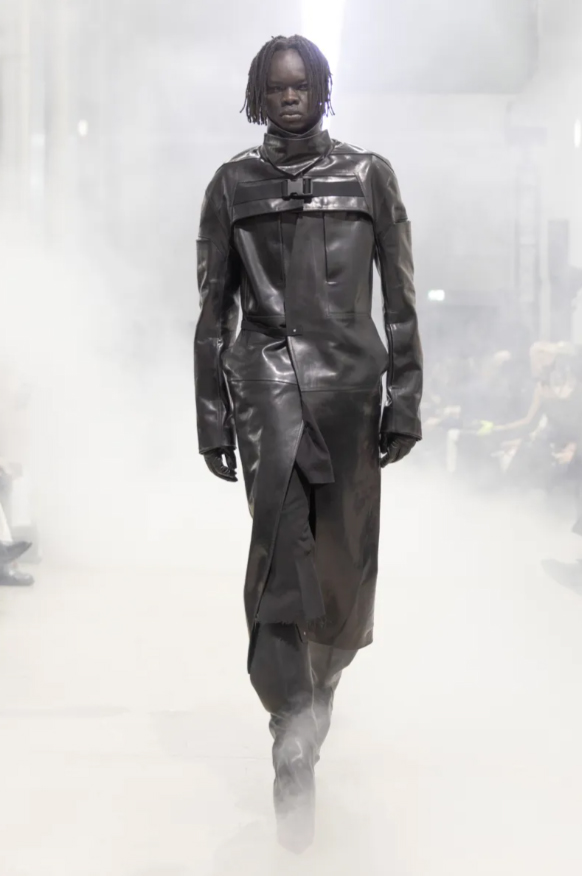
 The leather coats, almost stubborn in their rigidity, conveyed a dark and severe impression. Their sharply defined back vents, along with fastenings reminiscent of harnesses, seemed to carry within them the memory of martial discipline, as though these garments had been shaped not only for the body, but for an idea of authority and constraint. They evoked a world in which the individual bends to a greater, impersonal force that no one can ignore.
Owens, fully aware of this resonance, made no attempt to excuse it. He even admitted to having hesitated when he added shoulder pads to biker jackets and overshirts, sensing vaguely that this detail intensified an already heavily charged tension. Yet this hesitation did not divert him from his path. On the contrary, it drew him further in. He told himself that if there was any reason to commit fully, it lay precisely in this discomfort, in this diffuse unease that everyone today recognizes in the world around them.
He then thought of law enforcement, of its constant, unavoidable presence, rendered almost banal by how deeply it is woven into everyday life. Faced with the fear it can inspire, faced with the mute anxiety it sometimes embodies, he asked himself a simple and profoundly human question: how does one live with this?
Thus appeared deliberately oversized police boots, almost grotesque, as if excess itself could reveal the theatrical and absurd dimensions of authority. Their very existence seemed to suggest that solemnity is never invincible. And as if to dispel any ambiguity, they were offered not only in an expected, virile black, but also in an unexpected mint mauve, a soft, almost childlike color that introduced a troubling dissonance into this universe of force.
As for the fog that enveloped the scene, as was his habit, he never sought to justify it. He saw in it both mystery and danger, but also something deliberately excessive, almost naïve. The fog, he said, he loved it, for no reason other than that simple, unapologetic pleasure.
FM