
THE FASHION SHIFT
 AI Is Redesigning Fashion: China Takes the Lead. Should France Be Concerned?
Artificial intelligence is no longer operating on the fringes of the fashion industry. It is steadily embedding itself into every layer of the business and is beginning to reshape its very foundations, from collection design to the purchasing journey. What was considered experimental only yesterday has now become a fully fledged infrastructure, and luxury houses, whether they welcome it or not, must adapt to this new reality.
China Is Accelerating, Methodically
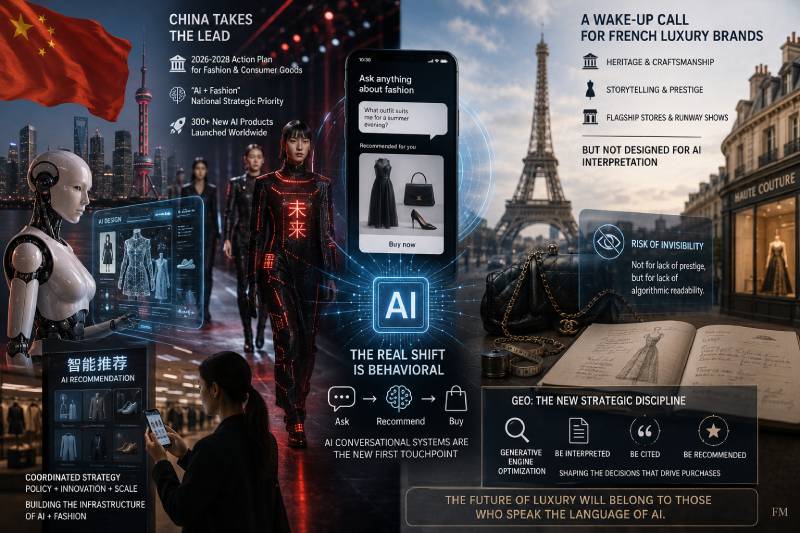
Nowhere is this transformation more visible than in China, where three major developments converged in a single month. Shanghai unveiled its 2026-2028 Action Plan for Fashion and Consumer Goods, making “AI + Fashion” a national strategic priority. At the same time, Chinese companies introduced more than 300 new AI products worldwide, a wave of innovation reflecting a clear determination to establish leadership before competitors have time to respond.
This is no longer about isolated technological breakthroughs. It is a coordinated convergence of public policy, aggressive commercial deployment, and continuous experimentation across fashion, retail, and consumer platforms. China is no longer testing AI in fashion. It is turning it into a foundational pillar of its industrial infrastructure.
The Real Shift Is Behavioral
While technology is advancing at remarkable speed, it is consumer behavior that is changing most profoundly. The traditional shopping journey, search, compare, filter, buy, is giving way to a far shorter sequence: ask a question, receive a recommendation, make a purchase. AI-powered conversational systems are becoming the first point of contact between brands and consumers, often before shoppers ever visit a website or step inside a store.
This transformation is redefining a concept the luxury industry once believed it had mastered: visibility. In a world where product discovery increasingly depends on AI assistants, brands that fail to structure their content so it can be read, understood, and accurately interpreted by these systems risk disappearing from recommendations altogether. They become invisible, not because they lack prestige, but because they lack algorithmic readability.
A Wake-Up Call for French Luxury Brands
This is precisely where French luxury houses face a significant challenge. Their reputation has been built on heritage, craftsmanship, and carefully crafted brand storytelling expressed through flagship stores, runway shows, and meticulously orchestrated advertising campaigns. Yet this language, however sophisticated, was never designed to be interpreted by artificial intelligence tasked with synthesizing, comparing, and recommending products within seconds.
GEO: The New Strategic Discipline
Against this backdrop, Generative Engine Optimization (GEO) is emerging as a critical strategic discipline. The objective is no longer simply to rank well on traditional search engines, but to ensure that AI systems correctly interpret, cite, and recommend a brand as they increasingly shape consumer purchasing decisions.
For French brands, the message is unmistakable. Ignoring this transformation would be equivalent to repeating, in the age of artificial intelligence, the mistake many companies made during the rise of the internet two decades ago: believing that reputation alone could compensate for a lack of digital structure. French luxury possesses unparalleled craftsmanship. What it must now learn, and quickly, is how to speak the language of the machines that increasingly determine what consumers will see.
FM