
LOUIS VUITTON: WHO OWNS A FLOWER?
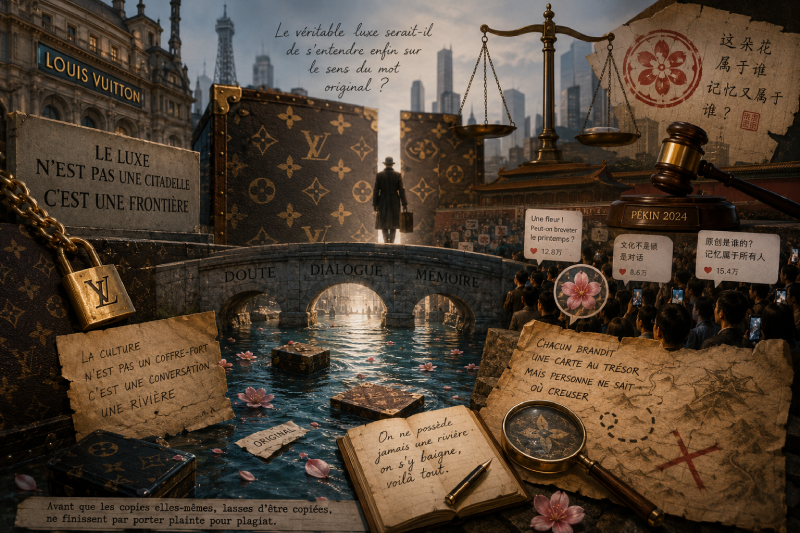
For a long time, I believed luxury was a fortress. I was mistaken. It is a frontier, and like all frontiers, it attracts those who dream of crossing it without a visa. Louis Vuitton has just learned this lesson in Beijing, where the courts are once again being asked to decide who owns a pattern, a question which, phrased differently, becomes: who owns a memory?
The case itself is hardly extraordinary. An entrepreneur named Huang Min Yao is said to have registered, in 2024, a design strikingly similar to those the French maison has regarded as its own for more than a century. The court listened, weighed the arguments, and hesitated, for justice, like old love affairs, sometimes prefers not to reach a conclusion too quickly. I call this the elegance of doubt: taking the time to choose one’s words before carving them into the marble of a judgment.
Yet there was something in the air in Beijing that the lawyers had not anticipated. An entire nation began debating on social media what had started as little more than a dispute over trademarks and patents. Hundreds of thousands of voices transformed the lawsuit into a mirror held up to the West, which sometimes imagines that beauty has only one postal address.
For this is the dizzying paradox of our century: a French brand that has become global confronting a Chinese brand that has likewise become a citizen of the world, with both laying claim to a flower. A flower! As though one could patent spring itself. Carwyn Morris, widely regarded as a perceptive scholar, put it perfectly: culture is not a vault; it is a conversation. And I would add, speaking as an incurable romantic: it is a river. No one ever owns a river. One simply bathes in it, and sometimes leaves behind, through carelessness or pride, the illusion of having been its sole proprietor.
Everyone in this story is clutching a treasure map. The misfortune, or perhaps the grace of it, depending on one’s mood, is that no one agrees where to dig. Perhaps true luxury, the kind no counterfeit could ever imitate, would be to agree at last on the meaning of the word original, before the copies themselves, weary of being copied, decide to sue for plagiarism.
FM