THE END OF EVERYTHING
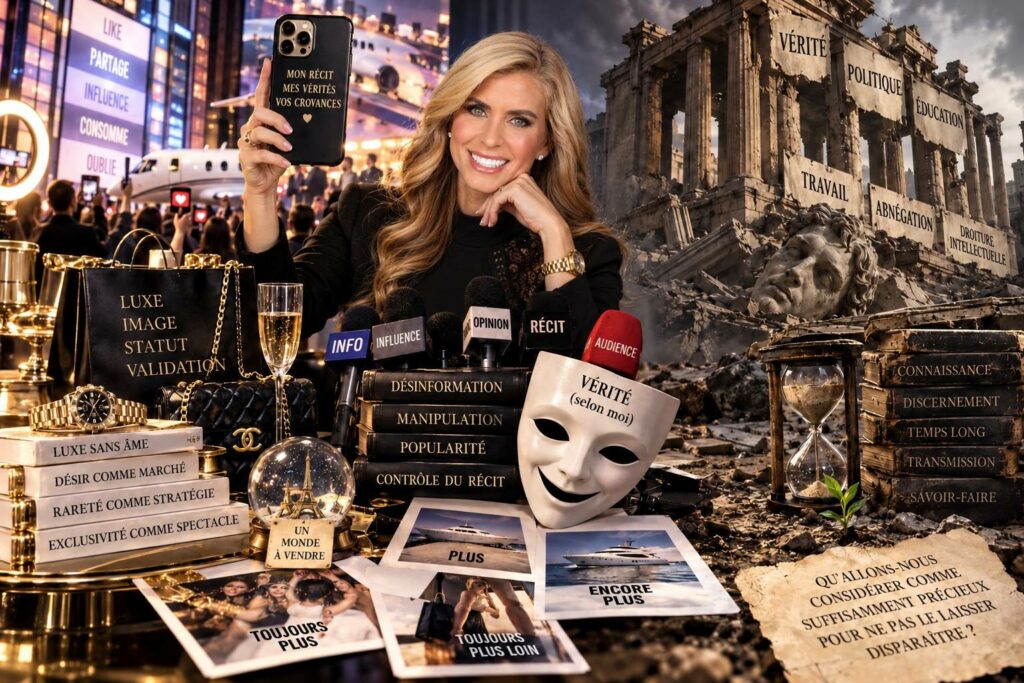
Are we witnessing the disappearance of a world? Something is coming to an end before our very eyes. Something almost invisible: a silent transformation of our relationship with the world, with others, and with ourselves. As though, behind the constant noise of current events, a civilization were gradually losing, one by one, the values upon which it was built.
Perhaps this is the defining phenomenon of our time: the end of truth, the end of politics, the end of education, the end of luxury, the end of work, self-sacrifice, and intellectual integrity. Not necessarily the disappearance of these realities themselves, but the gradual erosion of what they once meant.
Truth has perhaps never been so accessible, and yet it has never seemed so vulnerable. Everything is known, everything is shared, everything is challenged. But this abundance does not necessarily produce greater knowledge. Sometimes, it generates a confusion in which truth and falsehood coexist without distinction, until, for some, they become two equally valid opinions.
The question is no longer what is true, but what people can be made to believe. The distinction is immense. In the first case, we seek to understand the world. In the second, we seek to impose our own narrative.
When truth becomes a matter of popularity, knowledge turns into a competition and intelligence into an instrument of persuasion. The issue is no longer merely one of misinformation. It is the disappearance of an inner moral imperative: the obligation not to lie, even when lying serves our interests.
Luxury is another revealing reflection of our age, because it touches upon money, desire, taste, and time.
Luxury, in its most demanding sense, has never simply been a question of price. It could embody mastery of a craft, the rarity of a material, the transmission of expertise, the patience required in its making, and a particular vision of beauty. It told a story: that of an object whose creation demanded time, skill, and exceptional care.
But what becomes of luxury when its value depends more on its visibility than on its quality? When the point is no longer simply to own an object, but to demonstrate that one possesses something others recognize as desirable?
Luxury then risks becoming a social language, an outward symbol of distinction, an instrument of validation. The object matters less for what it is than for what it allows its owner to communicate. Rarity becomes a strategy, desire becomes a market, and exclusivity becomes a spectacle.
Of course, not everything can be reduced to this evolution. Craftspeople, fashion houses, and designers continue to defend an uncompromising vision of their work. Yet the tension remains: between the culture of the object and the culture of its image, between the slow passage of time required for creation and the fleeting immediacy of consumption.
Perhaps the ultimate luxury is no longer to possess more, but to retain the ability to distinguish what is truly worth possessing.
For if everything comes to an end, one question remains: what will we consider precious enough to refuse to let it disappear?
Perhaps this is the fundamental political, moral, and cultural question of our time. Not how to prevent the world from changing, but how to ensure that, in changing, it does not lose the very reasons that make it worth living in.
FM