
WHEN EVERYTHING FALLS APART
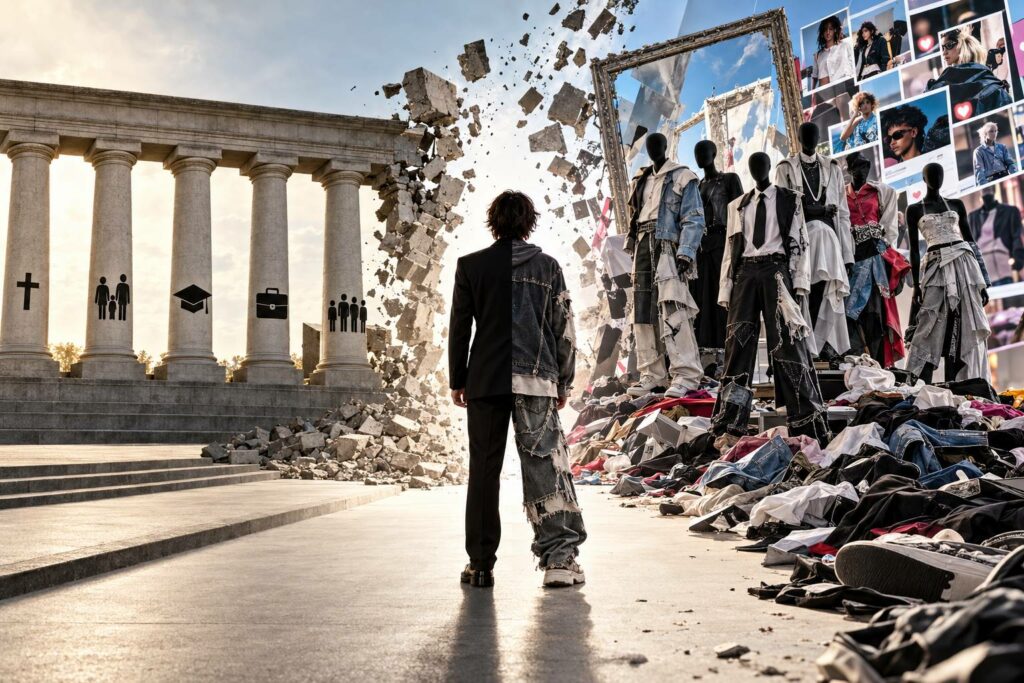
For centuries, Western societies stood firm thanks to a handful of solid foundations: religion, family, education, stable employment, social conventions… These institutions were not always kind to the people they governed, but they provided a framework and a sense of direction. For several decades now, however, they have been steadily eroding. Jean-François Lyotard spoke of the end of the “grand narratives,” while Zygmunt Bauman described a “liquid modernity” in which nothing has time to solidify.
Careers are no longer linear, couples and families are constantly being reshaped, beliefs are fragmenting, and authority is increasingly questioned. This movement, fuelled by individualism, technological acceleration, and growing distrust of institutions, has one simple consequence: the structures that once held society together no longer command a consensus, and every form of structure is now suspected of being a constraint in disguise.
Fashion, that sensitive mirror of its time, has not escaped this logic. As early as the 1980s, Martin Margiela and Rei Kawakubo were presenting garments with exposed seams, inside-out linings, and deliberately unfinished silhouettes. What was once an avant-garde gesture has now become commonplace: ripped jeans, oversized jackets, suits without shoulder pads, genderless clothing, sneakers worn with tailored suits. The dress code has lost its authority, and the tie, like the strictly tailored suit, has become a choice rather than an obligation. Clothing no longer declares, “This is my place in society,” but rather, “This is who I am today, for a few hours.” And social media, spreading trends at the speed of light, completes the dissolution of shared conventions.
But should we be alarmed by this? This dismantling of established structures has genuine merits: it liberates bodies, loosens the constraints of gender and class, and allows everyone to invent their own style. Yet it also comes at a price. A backbone does more than restrict movement; it allows us to stand upright. And without shared points of reference, freedom can turn into anxiety, fragmentation, and an endless search for identity.
We cannot reinvent ourselves without having something to lean on, and even fashion’s greatest deconstructionists first understood the rules they were breaking. Today, the new Deconstructionists have nothing to stand on. Perhaps the challenge of our time is not to choose between structure and freedom, but to rebuild flexible foundations, strong enough to support everyone and open enough not to suffocate them. And that becomes considerably more difficult when you’re surrounded by a bunch of idiots.
FM