
DIOR PLANTS ITS JUNGLE
 Dior planted its jungle. It took a certain audacity to transform the Rodin Museum into a climate-controlled Amazonian greenhouse, complete with a hefty carbon footprint, all so that Sabrina Carpenter and Naomi Watts wouldn’t have to put their coats back on between the taxi and the front row. Jonathan Anderson, the House’s head gardener, imported ferns, recorded cricket sounds (despite the fact that there are no crickets in the Amazon), and the damp heat of a tropical forest in the middle of winter. The sort of extravagance that costs a fortune in logistics just to proclaim, from an iceberg sponsored by Miko, that nature is something you recreate once you can afford never to experience the real thing again.
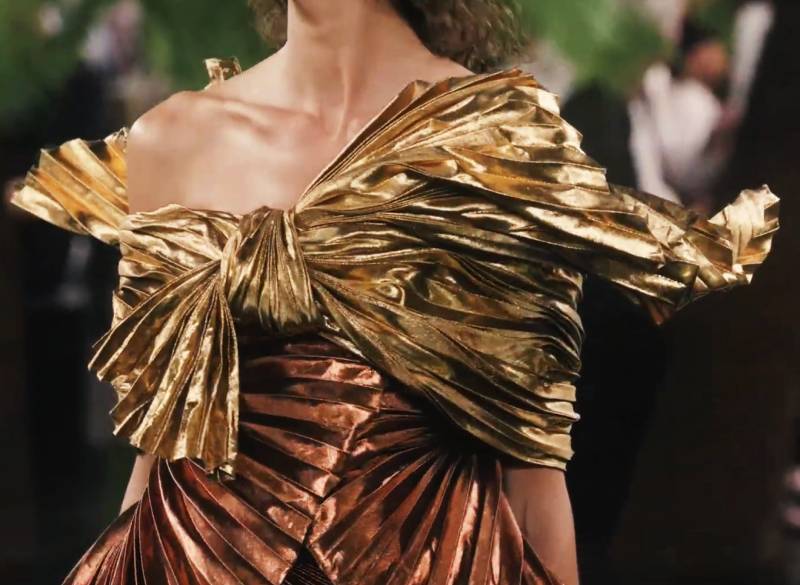
Beneath the leafy canopy came dresses knotted and draped like bronze butterflies, an explicit tribute to Lynda Benglis and her twisted sculptures of the 1980s. The difference is that the sculptor poured molten metal in a studio, not inside a climate-controlled showroom costing several million euros. The minaudières, co-designed by Benglis herself, complete the transformation of artwork into premium accessory: sculpture becomes handbag, art becomes storage, and everyone enthusiastically applauds this so-called “dialogue”, meaning luxury merchandising disguised as artistic exchange, with Anna Wintour leading the ovation.
The folkloric highlight comes in the form of chintz embroideries from Ahmedabad, where Benglis met her husband, now revived as a tasteful brand of Orientalism carrying the unmistakable scent of nostalgic Galliano. Dior, after all, has never hesitated to recycle its own ghosts.
A peacock’s tail fans across a bare back, an elegant quotation that mostly reminds us that at Dior, even the animals are expected to pose for the campaign. Beautiful, masterfully executed, undeniably. Yet one leaves this jungle wondering whether the rarest form of exoticism today might simply be creating something genuinely new without quoting anyone at all.
FM