
CHINA TAKES THE LEAD
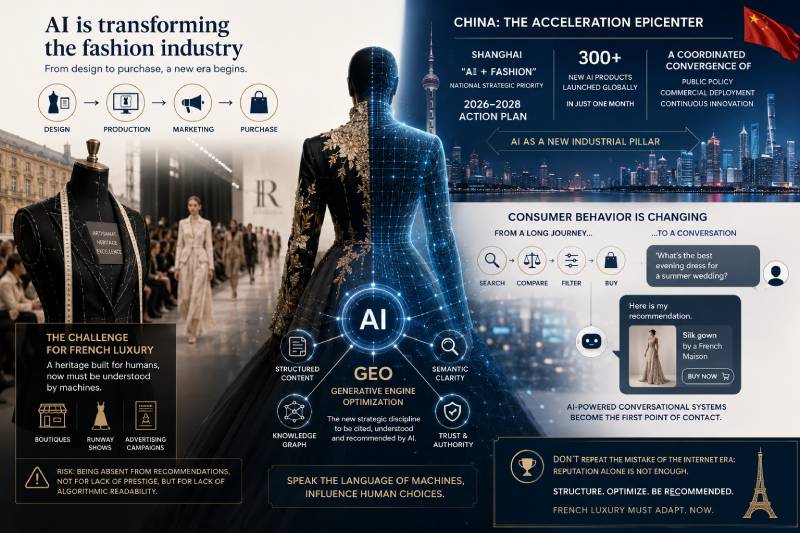
Artificial intelligence is fundamentally transforming the fashion industry, embedding itself into every stage of the business, from collection design to the purchasing journey. China best illustrates this acceleration: in a single month, Shanghai made “AI + Fashion” a national strategic priority through its 2026-2028 Action Plan, while Chinese companies launched more than 300 new AI products worldwide. This is no longer about isolated experiments, but a coordinated convergence of public policy, aggressive commercial deployment, and continuous innovation, turning AI into a genuine industrial pillar.
Beyond the technology itself, it’s consumer behavior that is changing most radically. The traditional shopping journey (search, compare, filter, buy) is giving way to a shorter sequence: ask a question, receive a recommendation, buy. AI-powered conversational systems are becoming the first point of contact between brands and consumers, often before any store visit or website browsing takes place. This redefines the concept of visibility: brands unable to structure their content to be understood by these systems risk disappearing from recommendations, not for lack of prestige, but for lack of algorithmic readability.
This shift represents a major challenge for French luxury houses, whose reputation rests on heritage, craftsmanship, and brand storytelling designed for human-facing channels (boutiques, runway shows, advertising campaigns) rather than for interpretation by AI. Against this backdrop, GEO (Generative Engine Optimization) is emerging as a new strategic discipline aimed at ensuring AI systems correctly cite and recommend a brand. For French houses, the message is clear: ignoring this transformation would mean repeating the mistake made at the dawn of the internet, relying on reputation alone rather than proper digital structuring. French luxury must now quickly learn to speak the language of the machines that increasingly shape consumers’ purchasing decisions.
FM