
FASHION THE PRICE OF SUSTAINABLE ILLUSIONS
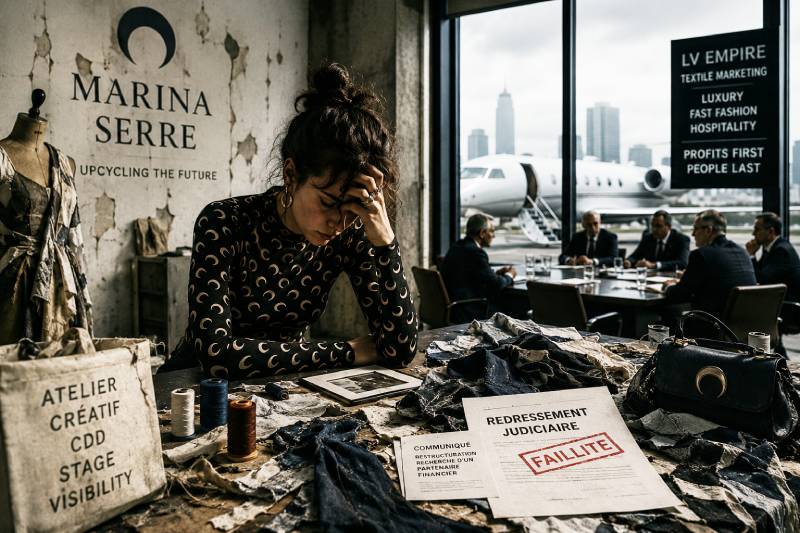
Once upon a time there was a young woman who believed you could stitch a broken world back together with a sewing machine and a handful of good ideas. Her name was Marina Serre. She was twenty-six, armed with genuine talent and the kind of innocence luxury conglomerates can smell from miles away, like vultures circling something that’s still breathing.
Today, her fashion house is under court-supervised restructuring. The official statements blame “economic conditions.” Translation: the fruit has been squeezed dry, and the people holding the press are already boarding private jets in search of the next one.
The story always begins the same way.
A luxury empire claims it has “discovered” a promising young designer fresh out of fashion school. Like Columbus “discovering” a continent that was already inhabited. They promise mentorship, runway shows, investors, glossy magazine covers, a place in fashion history.
In return?
A few signatures at the bottom of contracts no twenty-two-year-old creative actually reads. Because at that age, you’re dreaming about Paris Fashion Week, not intellectual property clauses.
Then the machine starts running.
The magic word appears:
Upcycling.
Suddenly every discarded curtain becomes an environmental manifesto. Every ripped pair of jeans becomes an act of rebellion. Every jacket becomes proof that fashion can save the planet.
A moral detergent sold at cashmere prices.
Recycling was no longer a craft.
It became a religion.
And like so many modern religions, its greatest miracle was cleansing consciences while inflating profit margins.
No one asked who was actually sewing these miracles together.
No one asked how many hours of labour it took to transform piles of discarded clothing into luxury objects priced higher than a month’s rent in Paris.
No one asked why the people building the legend were paid with internships, temporary contracts, and “exposure,” that counterfeit currency only the privileged dare call compensation.
Around Marina stood an invisible army dismantling cheap garments to create luxury accessories.
They called it the creative atelier.
A more honest name would have been the storytelling factory.
Meanwhile, the magazines faithfully recited the gospel:
“A visionary designer.”
“Responsible luxury.”
“A sustainable revolution.”
What an extraordinary performance.
Photographers lit the silhouettes.
Journalists illuminated the narrative.
Investors illuminated only their spreadsheets.
Because behind every fairy tale in fashion stands a legal department hundreds of pages thick.
Nobody finances talent out of love for art.
They invest in ownership.
Ownership of trademarks.
Ownership of patents.
Ownership of licenses.
Ownership of the story itself.
The designer is often little more than the face.
An elegant mascot.
A signature displayed for as long as it generates more revenue than expense.
Then the market slows.
Luxury platforms collapse.
Buyers disappear.
Growth stalls.
And suddenly the very executives who once proclaimed unwavering faith in their creative genius solemnly announce that “the business model is facing structural challenges.”
Remarkable timing.
For eight years they noticed nothing.
For eight years the dividends looked perfectly healthy.
So they cut the cord.
Withdraw the funding.
Publish a carefully worded press release.
And leave the designer standing alone among the ruins, her name attached to a bankruptcy whose real levers she may never have controlled.
The employees head back to the job market.
The interns become statistics.
The seamstresses stack unemployment forms beside cardboard pattern templates.
The investors simply move on to the next PowerPoint presentation.
It is fashion’s oldest magic trick.
Put a woman on the cover.
Put financiers on the cap table.
Privatize the profits.
Socialize the wreckage.
And when everything falls apart, it is never the investment fund that becomes the public face of failure.
It is always the person whose name appears on the label.
That is the industry’s real product.
It doesn’t manufacture clothes.
It manufactures myths.
Disposable prodigies.
Contracted geniuses.
Then perfectly identifiable scapegoats.
Somewhere else, right now, another brilliant fashion student is presenting her graduation collection before a captivated audience.
Somewhere else, another luxury group is saying it simply wants to “support her.”
Somewhere else, lawyers are already drafting contracts while communications teams are writing tomorrow’s legend.
Fashion loves talking about cycles.
This is the one cycle it never allows onto the runway.
FM