
CALDER WHERE VUITTON MAKES THE GAZE LEVITATE
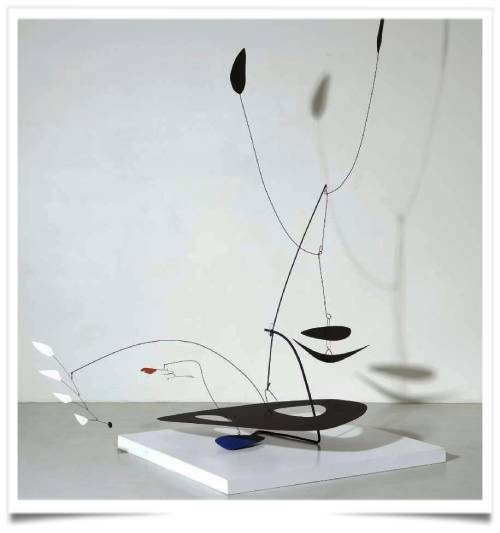 From the very first moment, the visitor’s gaze seems seized by an invisible hand, held briefly in a suspension almost sacred, where a vast constellation of vermilion forms unfolds, their impulses appearing to converse with Gehry’s diaphanous sails, as though the architecture itself had consented to become breath. Nothing here weighs any longer according to the ordinary laws of matter: the sculpture does not impose itself, it breathes, it floats, it seems to listen to the very silence of space, and to merge with it like a thought made visible before the Lord.
Further along, the path bends toward an early work, Calder’s Circus (1926–1931), on loan from the Whitney Museum of American Art, which appears like a miniature world where the infinite hides beneath the guise of play. These figures of wire and light fabric, these fragments of objects transformed into characters, evoke less a construction than a waking dream. One almost hears the artist’s voice still, as if he had only just left the room, leaving behind this troupe ready to resume its fragile dance at the slightest breath of memory.
Yet from this turbulence emerges a kind of quiet contemplation. The Constellations of the 1940s rise like inner skies, woven of wood and wire, fragile architectures of balance and effacement. Born in the shadow of the troubled hours of war, they seem to suspend the world in a wordless meditation, where each element hesitates between presence and disappearance, like a star consenting to be no more than the memory of light.
Further on, certain works take on almost organic accents, as though nature itself had agreed to enter into metal. Black Widow (1948) extends its dark lines with an uneasy grace, an arachnid vision that seems to keep watch over the void. One also encounters Lily of Force (1945) and Bougainvillier (1947), where iron becomes aerial blossoming, and where the heaviness of materials is forgotten in a kind of suspended elation, defying the tacit laws of gravity.
The exhibition does not neglect the sonic vibration of things, with Dispersed Objects with Brass Gong (1948), where movement generates resonance, and where the work exceeds itself to become listening. As for the Mercury Fountain (1937), presented here as a model, it recalls a Calder attuned to the sufferings of his time, responding to the convulsions of the Spanish Civil War with a troubled, almost liquid material, where beauty mingles with unease like a smile veiled in mourning.
Thus one moves through the rooms as through successive worlds, now vast, now secret, where scale is constantly reversed, from the minuscule to the monumental, from play to gravity, from dream to political thought. Loans from the Museum of Modern Art, the Art Institute of Chicago, and the Centre Pompidou, along with numerous private collections, lend this gathering of works an almost unrepeatable brilliance, as though time itself had agreed to assemble its fragments for a singular moment.
More than a retrospective, Dreaming in Balance appears as a suspension of the world within its own vertigo. Calder does not appear here merely as the inventor of the mobile, but as a poet of invisible forces, an orchestrator of winds, gravities, and chance, who knew how to make of air itself a sculptural material.
And when one finally departs, there lingers in the soul a persistent, almost indefinable impression, as though the world, for a few fleeting moments, had ceased to be heavy, and had remembered its original lightness.