
ZARA ET JOHN GALLIANO
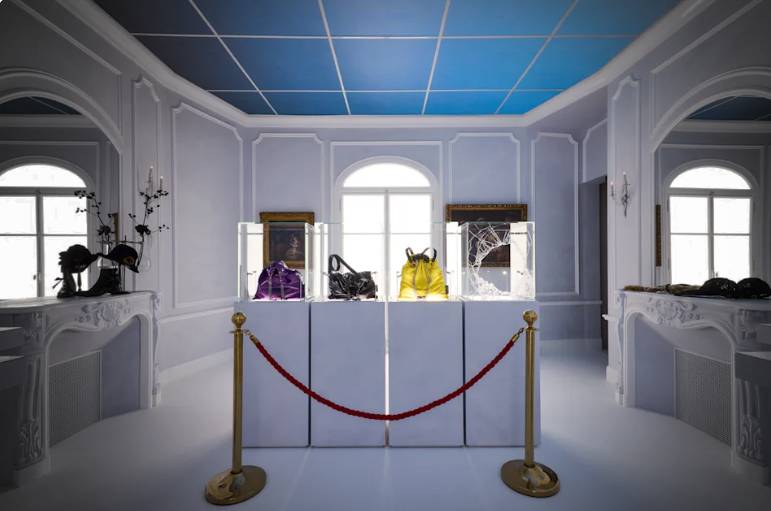
By taking over a hôtel particulier in the Marais, Zara is giving John Galliano the stage for his resurrection. The place where genius returns, precisely where no one expected to find it.
By appointment only, from Thursday to Tuesday, visitors are invited to an immersive exhibition tracing the origins of this new chapter in Amancio Ortega’s textile empire. But the word “exhibition” suddenly seems far too modest to describe what awaits us behind the doors of this grand Parisian mansion.
We are far, very far, from the commercial frenzy that surrounded the collaboration between Karl Lagerfeld and H&M more than twenty years ago. Back then, luxury came down into the streets, and crowds chased after clothes as if they were objects falling from the sky. It was the beginning of a long and sometimes unlikely relationship between mass-market retail and fashion houses.
Here, nothing of the sort. You need an appointment. And once through security, you enter a cobbled courtyard, almost unreal, laid out like a little Parisian neighborhood that somehow forgot to grow up.
Then the building gently swallows you.
Inside, it becomes difficult to tell whether you are in a fairground, an art gallery, or a museum. Perhaps all three at once. This is Galliano, quite simply: reality always has a hidden door.
The French architecture of the place, steeped in centuries and secrets, is bathed in artificial light that resembles moonlight. Video screens emerge from cracks in the walls, as though the past had suddenly decided to speak. There we see Galliano at work, handling clothes with that peculiar precision that turns fabric into a character, and a garment into a story.
Then comes a room devoted to the things that feed the designer’s imagination. Books, images, objects, all the things one accumulates when one refuses to let the world become ordinary. Ernest Hemingway’s novels sit alongside a statuette of Napoleon. The emperor and the writer seem to be waiting for something.
Perhaps for the apologies of the man from Toledo.
For this is how collections are born: not only in ateliers, but in memories, obsessions, books, and images that have survived the passage of time. Genius never creates entirely from nothing. It awakens what everyone else had stopped seeing. And when the journey comes to an end, visitors can finally buy pieces from the collection, Business is Business. They are displayed in two luminous rooms designed like haute couture salons.
Only then do we understand the real purpose of this elaborate mise-en-scène. Zara has not simply opened the doors of a hôtel particulier. It has built a stage for the return of a man who has always known how to do something rare: turn fashion into theatre, and theatre into memory.
Genius, sometimes, does not disappear. It simply waits for someone to give it a stage again.
FM