
MY GRANDMOTHER’S 2.55 HANDBAG
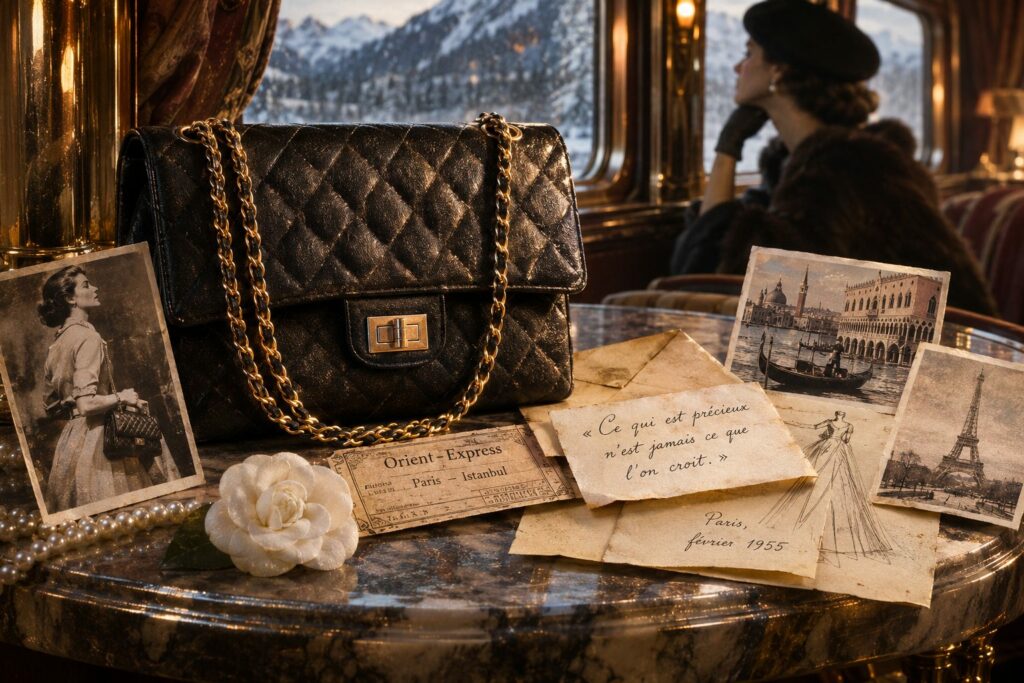
There are handbags that grow old, and others that travel through time without ever truly belonging to it. Such was the case with my grandmother’s 2.55. A small rectangle of quilted leather suspended from a golden chain, its diamond-shaped stitching seemed to hold more memories than the libraries of the most ancient palaces. My grandmother used to say that a handbag should never be entirely emptied. Something must always be left inside: a forgotten train ticket, a letter never sent, a photograph whose faces one no longer recognises. For an empty handbag, she would say, was a handbag without a soul.
But this one held a secret.
It had all begun one winter evening, when she was still a young woman leaving Paris aboard the Orient Express. Her only luggage was a small suitcase and that famous Chanel handbag, a gift from a Polish count as handsome as a Greek god, received under circumstances she had never wished to reveal.
In Venice, a mysterious woman dressed in black approached her in the lobby of the Danieli. Without introducing herself, she glanced at the handbag and whispered:
“Madam, do you have any idea what you are carrying?”
My grandmother smiled, mistaking the remark for a simple expression of admiration for the elegance of the object.
But the stranger continued:
“This handbag has already saved one life. And it will save another.”
Then she vanished, leaving behind an enigmatic message that would remain unanswered.
A few days later, in Istanbul, my grandmother discovered a tiny, yellowed envelope concealed at the bottom of the inner pocket. Inside, a slip of paper bore a Parisian address, a date, and these few words:
“What is precious is never what we believe it to be.”
The address led to an old couture atelier that had been closed for decades. Behind a sealed door lay an untouched room, where unfinished gowns, sketchbooks and the portrait of a woman carrying exactly the same handbag had remained undisturbed. On the back of the painting was an inscription: Paris, February 1955.
My grandmother then understood that her handbag was more than a mere accessory. It was the last witness to an ancient promise, passed from woman to woman, across borders, through wars, love affairs and disappearances.
The years went by. The leather softened, the chain lost a little of its lustre, and the handbag accompanied my grandmother through grand occasions and ordinary days alike. It witnessed lavish dinners, hurried departures, tears held back, and those moments of happiness that are never captured in photographs.
Then, one day, she handed it to me.
“Take it. It still has a long way to go.”
I gazed at it for a long while. It was no longer new, but it possessed a beauty that money could never buy: the beauty of things that have lived.
As I opened its little inner pocket, I discovered a small square of folded paper that I had never noticed before. Unfolding it, I found a few words written in my grandmother’s own hand:
“Now, it is your turn to write the rest of the story.”
And at last, I understood. The true treasure had never been hidden inside the handbag.
The treasure was the story it had lived.
FM