
THE FOUR SEASONS ON THE EDGE OF THE ABYSS
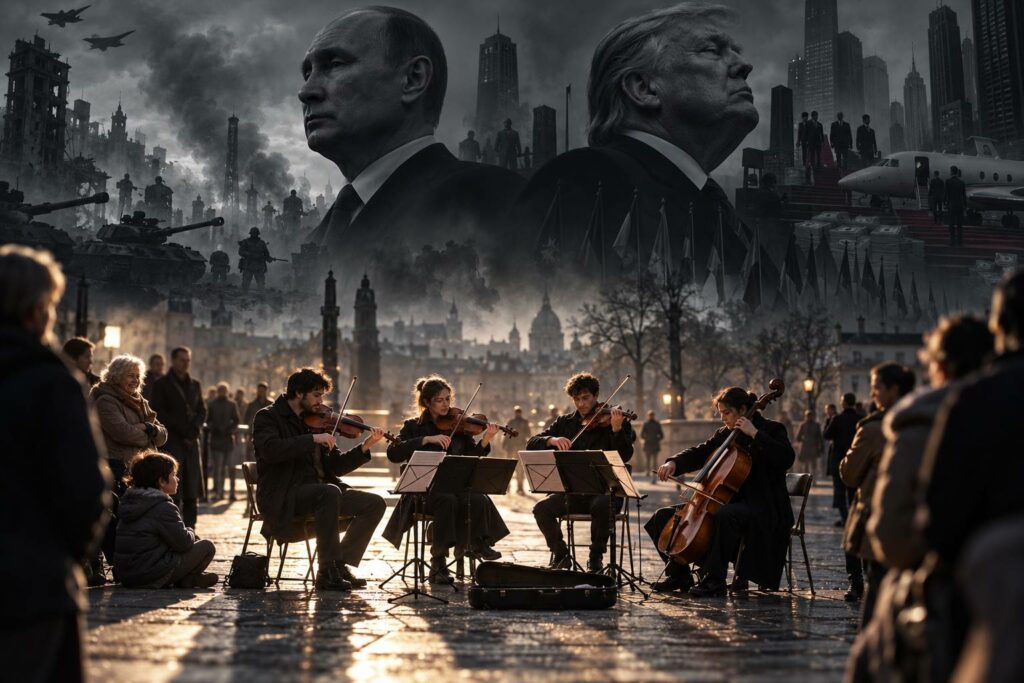
I look at this world, and I no longer recognize it! Or perhaps it is the world that, having shed its last masks, is finally revealing its true face. A hideous face, disfigured by money, vulgarity, violence, and that unfathomable stupidity that now seems to pass for political intelligence.
Monsters no longer hide beneath children’s beds. They sit in palaces, travel in private jets, hold press conferences, and shake hands stained with blood beneath rows of flags. They command armies, possess billions, and enjoy millions of witless admirers.
A Putin who bombs, a Trump who bellows, and a proliferation of cheap little “Schicklgrubers.” Some dream of empires, others of walls, territories, domination, or revenge. None seems to dream of beauty. None seems to wonder what the world might become if we taught children to listen to a violin before teaching them to hate their neighbors.
I picture them sitting in front of a piano. The sight would be almost comical if it weren’t so tragic. Their fingers, accustomed to signing decrees, naming enemies, and counting billions, would probably be incapable of drawing an emotion from a single ivory key. We have seen it for ourselves when the lord of the manor sits down to play: he struggles to evoke even the faintest feeling.
We have entrusted the fate of the world to men who know how to conquer territories, but who would be incapable of winning a heart by any means other than fear.
Meanwhile, our society continues its descent into an abyss whose bottom no one can see anymore. The rich have become so rich that they no longer know what to buy. The poor have become so poor that they no longer know what to hope for. Caught between the two, an exhausted humanity races after screens, appearances, and promises of happiness delivered within twenty-four hours.
We no longer talk; we post. We no longer love; we consume. We no longer think; we react. Compassion has become suspect, culture a luxury, intelligence a provocation, and vulgarity a remarkably effective career strategy.
We have invented machines capable of speaking on our behalf, yet we no longer know how to speak to one another. We have sent probes to the farthest reaches of the solar system, yet we are incapable of reaching out to the person sleeping on the pavement across the street. Technological progress advances at a dizzying pace. Human progress, meanwhile, seems to have missed the last train.
There is something profoundly humiliating about belonging to a species capable of producing Bach, Mozart, Beethoven, and Vivaldi, yet seemingly fascinated today by characters whose principal talent is to shout louder than everyone else.
And then, the other day, on a gray street, as I walked along expecting very little from that particular day, I heard a few notes. Four musicians were playing Vivaldi’s The Four Seasons: two violins, a viola, and a cello. No spotlights, no bodyguards, no billions. Just four human beings capable of transforming the vibrations of a few strings and pieces of wood into an emotion that all the powerful people on this planet, gathered together, would be incapable of producing.
Passersby stopped. An elderly woman smiled. A child listened, spellbound. At that moment, I thought of Putin, Trump, and all those emperors of nothingness who spend their lives trying to leave their mark on history. Vivaldi died in 1741. He had no missiles, no financial empire, no army. And yet, nearly three centuries later, four strangers were still bringing his genius to life on a street corner. That is true power: the kind that brings people together instead of tearing them apart.
The piece came to an end, and as I walked away, I thought that those four anonymous musicians had probably done more for humanity in fifteen minutes than all those leaders had done in their entire lifetimes. And as long as there are four musicians on a street corner willing to play The Four Seasons, perhaps this world will not be entirely lost after all.
FM