
ALL HYPE, NO HAUTE
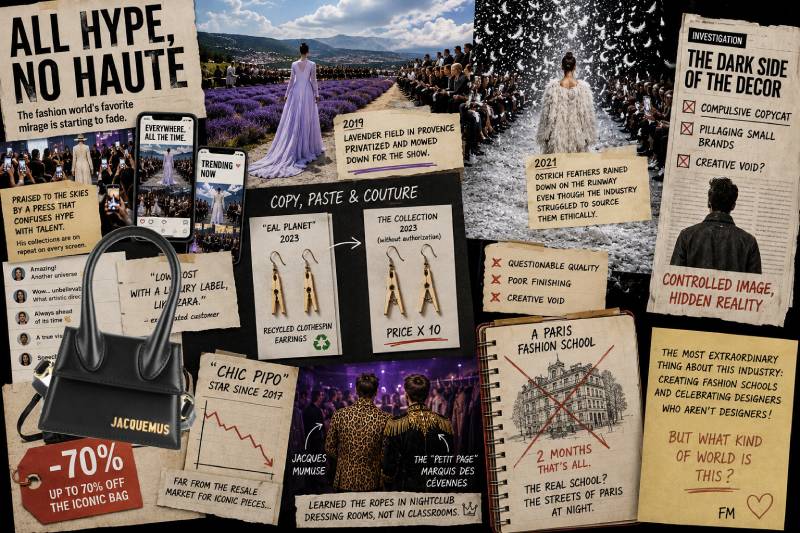
Hailed by a press that confuses hype with talent, his collections are endlessly showcased across every screen. The few killjoys who point out the constant “déjà vu” in his silhouettes are not enough to discourage him, nor are the criticisms of the carbon footprint of his fashion shows staged in the middle of nature. We still remember that lavender field in Provence, privatized in 2019 and mowed down for the occasion, or the 2021 show held under a rain of ostrich feathers, even though the industry was struggling to source them ethically.
Away from the carefully controlled image managed by his PR department, the reputation of the house of vanities is beginning to crack badly. The man turns out to be a compulsive copycat, shamelessly raiding small independent brands that have neither the resources nor the lawyers to defend themselves. This was the case, among others, with “Eal Planet” and its recycled clothespin earrings in 2023, whose idea he allegedly reused without permission under his own name, at ten times the price, without a word of acknowledgment or authorization. “Low-cost with a luxury label, like Zara,” complained one exasperated customer on social media. Customers who paid full price are complaining en masse about the questionable quality of the finishing, while others are openly denouncing the creative void behind the packaging.
In short, things are getting pretty noisy on the customer-service front. A sign that the magic is fading: his signature bag, the “Chic Pipo,” a star since his debut in 2017, is now being discounted by as much as 70%. That is a long way from the resale market for iconic pieces, which gain value over time rather than losing it. Clearly, marketing stunts will never replace the substance of true classics.
And the most delicious part of it all: Jacques Mumuse, along with his loyal right-hand man, the “Petit Page,” Marquis des Cévennes, did indeed attend a Paris fashion school when they began their careers, only to leave after two months, apparently preferring to learn the tricks of the trade in the changing rooms of Paris nightclubs rather than in a classroom. That is what is most extraordinary about this industry: creating fashion schools and celebrating designers who are not actually designers! But what kind of world are we living in?
FM