THE KISSES OF A PILGRIM COUTURIER
There are hours when the memory of peoples resembles those mysterious machines that abolish the distances of time. No sooner do we contemplate them than they set us down on the threshold of that dawn of the twentieth century, when Paris, clothed in her universal glory, seemed to have summoned beneath her sky all the nations of the earth. The iron tower, once an object of scorn, now dominated human hopes like those monuments that genius raises despite men, before they consent to admire them. It was the Universal Exposition of 1900; it was the moment when the Hôtel Régina opened its gilded salons to a generation of women whose names History did not yet know, because they were busy giving themselves that name. They no longer asked for freedom: they embodied it.
Franck Sorbier today revives these travelers of the unknown, these heroines whom no century ever fully managed to define. They had left the palaces without renouncing their nobility; deserted the salons without abandoning their grace; they wrote as others fight, they loved as one throws oneself into a storm; muses turned creators, tragediennes whom their own destiny raised to the level of poetry, adventuresses for whom the mask mattered less than the soul. Whether they were spies, dancers, novelists, or sovereigns of their own solitude, all obeyed the same call that of horizons which retreat the more one pursues them.
From their long crossings they had brought back that grave elegance known only to those who have known great departures. They had breathed the immense decks of the Normandie, that floating palace which cleaved the Atlantic with the majesty of a cathedral borne upon the waves, where iron seemed to have learned the gentleness of steam. They had walked the sumptuous carriages of the Orient Express, prince of railways and sovereign of journeys, linking London to the domes of Istanbul by way of Venice, Budapest, Belgrade, and Athens, sometimes extending its dream as far as the lands of Mosul and Baghdad, as though Europe and the Orient had never been anything but the two shores of a single, interrupted civilization.
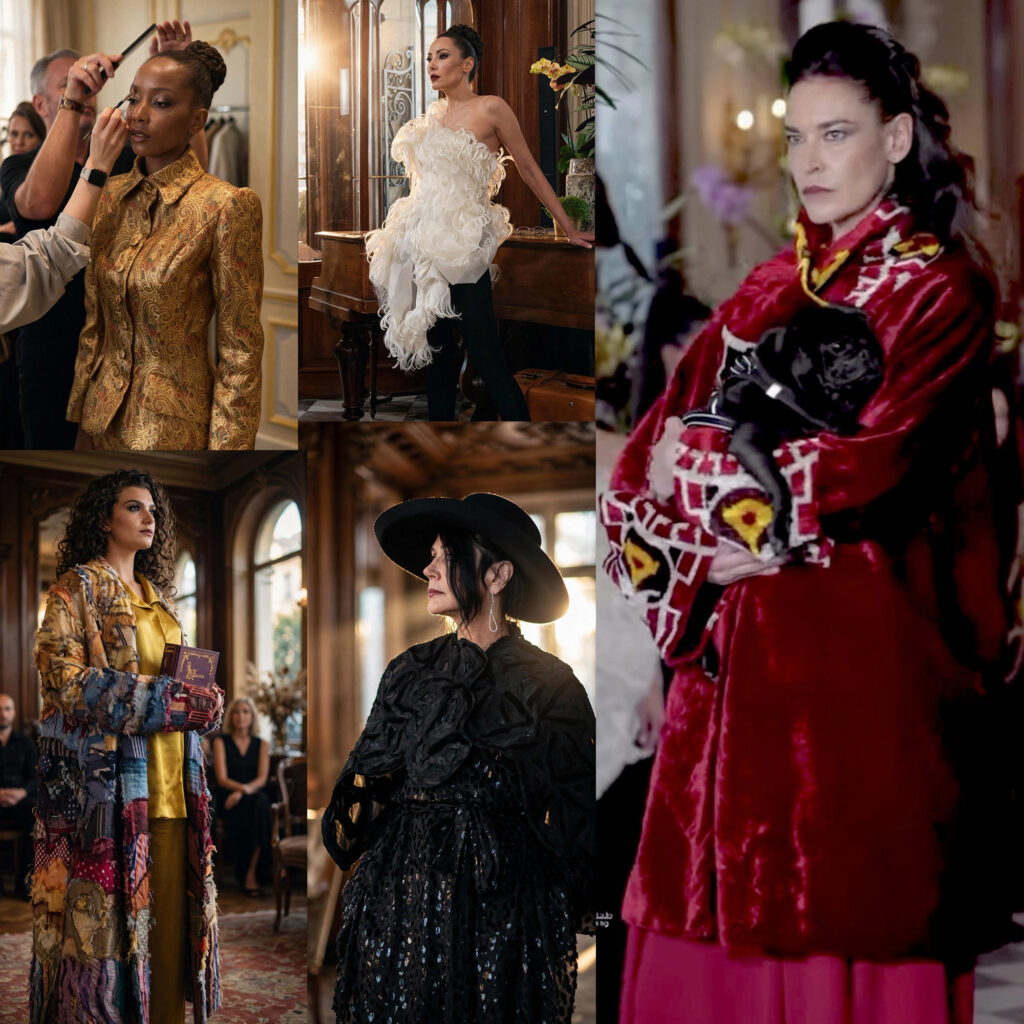
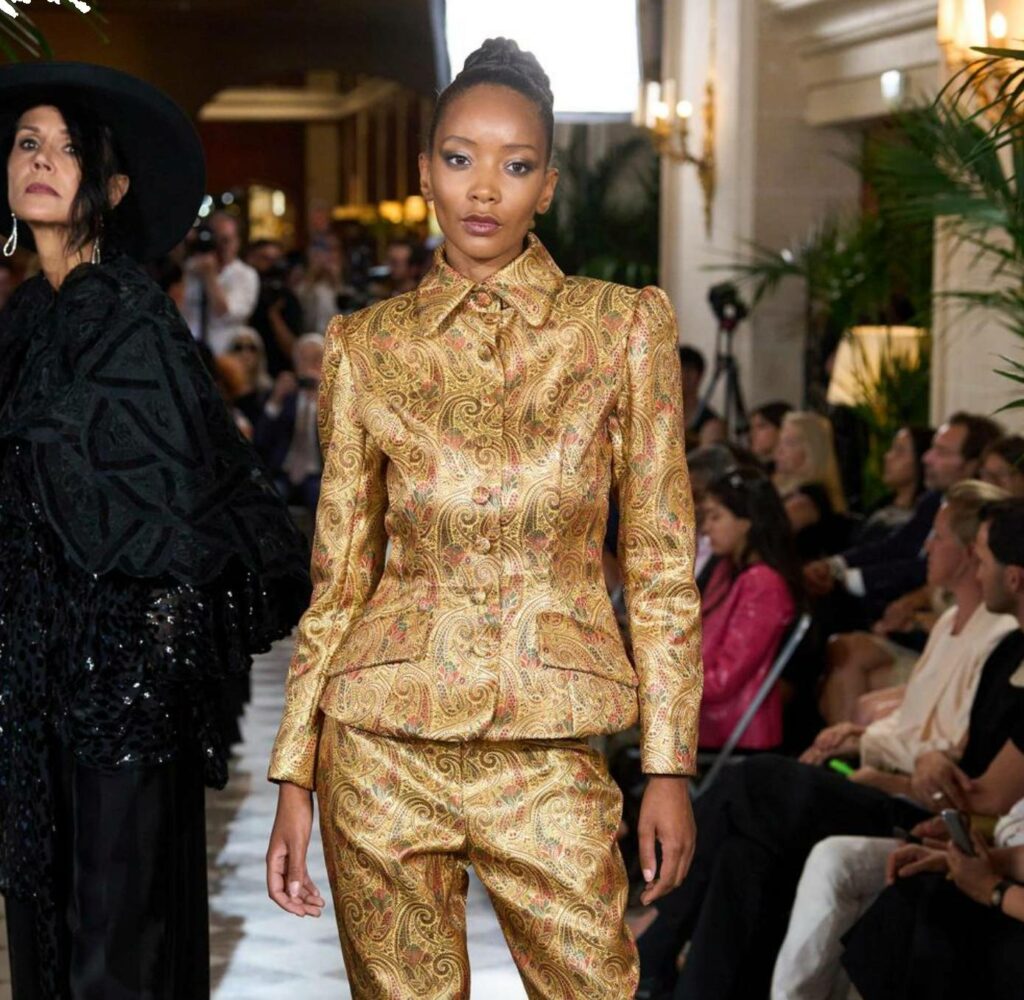
It is this vast dream that Franck Sorbier gathers and transposes into his 2026 collection. Under his gaze, the garment ceases to obey mere necessity and becomes a destiny. Trousers are no longer a social conquest: they are the silent sign of an accomplished independence, the garb of a woman who no longer waits for the road to be opened to her, because she herself has become the path. The coats wrap themselves in memories of Ottoman caftans, in the meditative suppleness of Japanese kimonos, in the house-robes of lands where scent still precedes the name of cities.
An ancient embroidery restores its memory to a black dress, as a fragment of fresco saved from ruins recalls a vanished empire. A scarlet coat is covered in a precious jacquard whose patterns evoke the marbled papers a devout traveler might have brought back from some forgotten Mediterranean port. The deep golds of Persia answer the delicate miniatures of Mughal India; silver lights up the darkness of velvet with the discretion of a star guiding the navigator; white and black do not war with one another here: they converse in that secret harmony where Yin and Yang abolish borders, where East and West discover that they were always the two breaths of a single world.
Thus Franck Sorbier pursues this geography of the soul that maps do not know. A stranger to the tyranny of fashions as much as to the clamor of seasons, he remains faithful to that nobility of travel which turns distances into memory and encounters into beauty. He calls us to embark without delay toward lands whose first frontier is the imagination, and sends us, from the four horizons of the world, the tenderest kisses of a pilgrim couturier.
FM