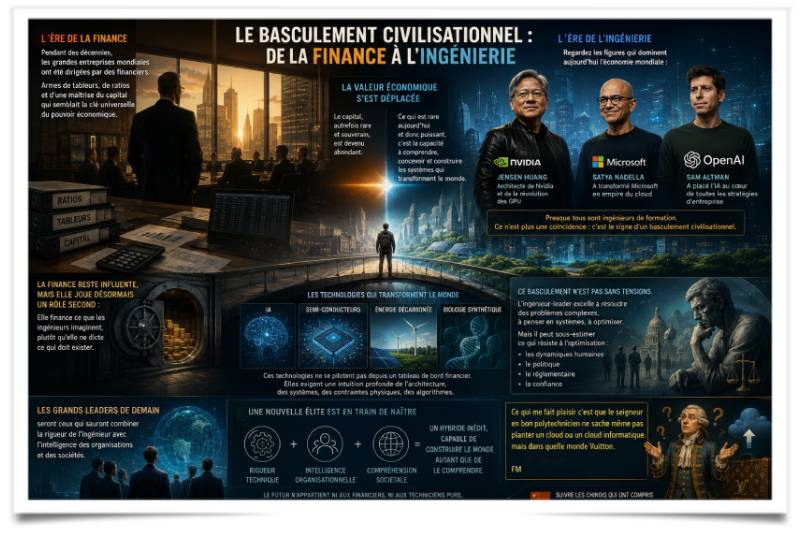
 For decades, the world’s largest corporations were led by financiers. MBA graduates from prestigious business schools sat at the top of organizational charts, armed with spreadsheets, ratios, and a command of capital that seemed to be the universal key to economic power. But something profound has shifted. Look at the figures who dominate the global economy today: Jensen Huang, the architect of Nvidia and the GPU revolution; Satya Nadella, who transformed Microsoft into a cloud-computing empire; Sam Altman, who placed artificial intelligence at the center of corporate strategy. Almost all of them are engineers by training. This is no longer a coincidence. It is the sign of a civilizational shift.
The reason is simple: economic value has moved. Capital, once scarce and therefore sovereign, has become abundant. What is scarce today, and therefore powerful, is the ability to understand, design, and build the systems that transform the world. Luxury has undergone a similar evolution through the rediscovery and renewed appreciation of traditional craftsmanship and the métiers d’art.
Artificial intelligence, semiconductors, decarbonized energy, and synthetic biology cannot be managed from a financial dashboard alone. These technologies require a deep intuition for architecture, systems, physical constraints, and algorithms. Finance remains influential, but it now plays a supporting role: it funds what engineers imagine rather than dictating what should exist.
This transition is not without tensions. The engineer-leader excels at solving complex problems, thinking in systems, and optimizing performance. Yet such leaders can underestimate what resists optimization: human dynamics, politics, regulation, and trust.
The great leaders of tomorrow will be those who can combine the rigor of the engineer with a deep understanding of organizations and societies, following the example of China, which grasped this reality earlier than most of the world. A new elite is emerging: neither pure technician nor pure financier, but a novel hybrid, capable of building the world as well as understanding it.
What amuses me is that the Lord, despite being a proud graduate of the École Polytechnique, would not know how to plant a cloud, whether a real one in the sky or a digital one in a data center.
FM