
WHEN REALITY BECOMES NEGOTIABLE
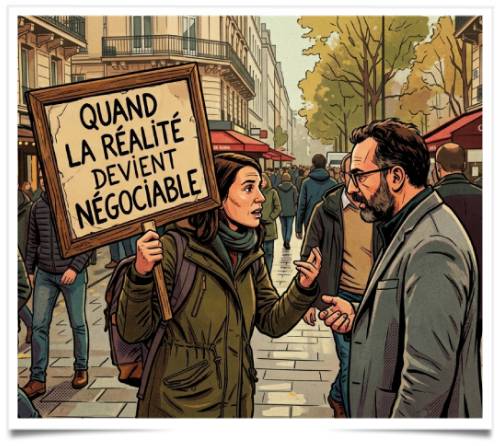
Today’s youth are growing up in a world where facts bend, where screens replace experience, and where Orwell’s shadow looms larger than ever.
There was a time when reality asserted itself naturally, raw and indisputable. One could touch stone, feel the rain, read newspapers with the conviction that words referred to something true. That time now seems gone. An entire generation has grown up within an ecosystem of filtered images, benevolent algorithms, and tailor-made narratives, where each user receives their own version of the world. Shared reality, the foundation of communal life, is fragmenting into thousands of islands of incompatible experiences. This is not merely a crisis of information; it is a crisis of existence itself.
“He who controls the past controls the future; he who controls the present controls the past.”
Young people’s perception emerges profoundly distorted. Not through malice, but through design. Platforms are built to maximize engagement, not truth. The child who opens a phone does not encounter the world, but a world, the one the algorithm has deemed most likely to hold attention. Cognitive biases take root early: if I see only opinions resembling my own, I eventually believe that everyone thinks as I do, and that those who think differently are mad, dangerous, or manipulated. Polarization is not an accident; it is the product of a perfectly oiled mechanism. A generation nourished by algorithms does not develop a critical eye, it develops only certainties.
This is where Orwell’s specter rises. In 1984, the Party seeks not merely to control actions, but also to control thought, erase memory, and make any alternative reality impossible. Newspeak impoverishes vocabulary in order to impoverish thought. Doublethink enables people to hold two contradictory truths without discomfort. Today, no Ministry of Truth is necessary: we have outsourced the task to private companies driven by motives less dramatic, yet with comparable effects. The newspeak of social networks, filter bubbles, and the constant rewriting of history through deletion, all of this sketches, in outline, the dystopia Orwell imagined. The difference, perhaps even more troubling, is that no one ordered any of it. We walked into it willingly, thumbs raised.
FM