DIOR MIRAGE UNDER THE TUILERIES SUN
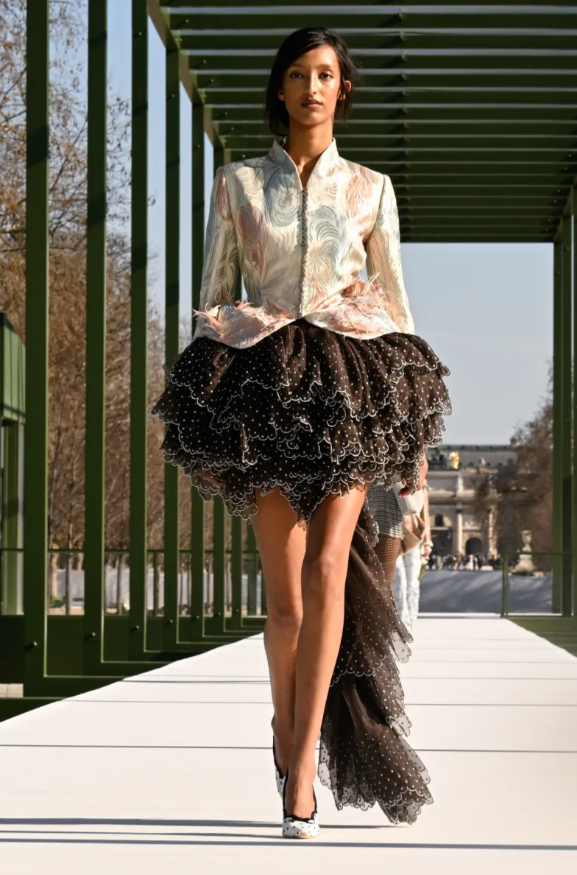 The sun, that worldly critic of Parisian high society, had decided to attend the show. It blazed with the insolence of a poorly aimed spotlight, turning the Tuileries Garden into an incandescent tearoom borrowed from Piton de la Fournaise. The traditional tent had vanished, exiled like an idea deemed too timid. In its place stood a mirrored architecture, delicate as a mischievous jewel, encircling a small octagonal lake. A runway hovered above the water, suspended between sky and reflection. My neighbor leaned over and whispered, “It’s the fashion duck pond.”
It was as if fashion, weary of its own riddles, had chosen at last to speak plainly. Gone was the conceptual labyrinth of the early days. Here was clarity, polished like a pebble. The designer had traded esotericism for sovereign simplicity, that rare virtue requiring far more courage than ornament.
Beneath the glass walkways, the heat rose with the slow drama of an opera. The front row guests, among them Jisoo and Anya Taylor-Joy, battled the temperature with the dignity of Greek statues suddenly aware of their own skin. A few influencers, scarcely returned from Dubai, wore that minimal makeup which claims spontaneity. Their complexions carried the carefully engineered freshness of a scheduled sunrise at Dubai Airport. They looked as though they had stepped out of an air-conditioned mirage, or perhaps a Mirage 2000, depending on one’s sense of humor.
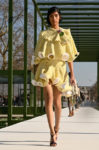
The spirit of the eighteenth century, that great powdered dramatist, hovered over deconstructed frock coats. Bustled skirts traced almond-toned arabesques in the air. Chantilly lace stretched like a treasured memory. Metallic jacquards captured the light with the appetite of a narcissistic mirror. This was a collection more vernal than expected. Ruffled skirts twirled like tutus intent on seizing power. Volumes rounded gently, as if shaped by a whispered confidence. Candy pink, chick yellow, ecru, sky blue. A palette suggesting an eighteenth-century confectioner reborn as a poet of fashion, something delightfully theatrical.
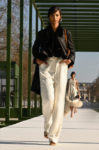
Then, with a gesture that felt almost ironic, came the so-called accessible novelties: ivory hammered-silk sweatpants adorned with covered buttons worthy of a wedding gown; jeans embroidered with ribbons, fragile as a promise; coat-dresses, simple and assured, worn without effort, already present in Dior boutiques yet now elevated to the status of public declaration. Here, democratization did not shout. It murmured with refinement.
The Bar jacket, the house’s disciplined icon, was reborn in Donegal tweed: elongated, tailored, controlled. Everything grew lighter, almost aerial. The silhouette sharpened without hardening. It moved forward freely, refusing to be pinned down by any final definition.
For fashion, when properly raised, never stands still. It transforms with the grace of a secret that refuses full disclosure. And on that runway suspended above the water, between heat and reflection, it seemed to smile at its own future.
FM