
WHEN LUXURY NO LONGER WAITS FOR THE AGE OF REASON
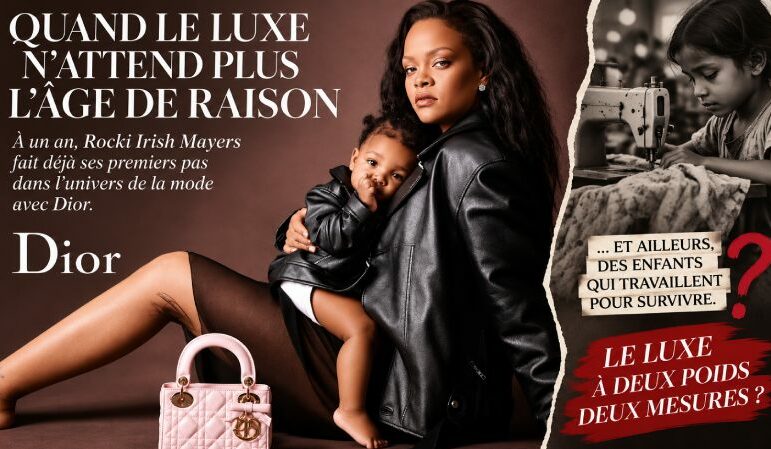
At just one year old, Rocki Irish Mayers, Rihanna’s daughter, is already taking her first steps into the highly lucrative world of luxury advertising. Alongside her famous mother, a longtime ambassador for the House of Dior, the little girl appears in a campaign dedicated to the iconic Lady Dior handbag. It marks an extraordinarily early entrance into the fashion world, following a much-noticed appearance in the pages of W magazine, where Rihanna wore a haute couture creation while her daughter sported a diaper and a floral headpiece specially designed by Jonathan Anderson.
At an age when most children are barely learning to walk, Rocki has already achieved what thousands of professional models can only dream of: starring in a campaign for one of the world’s most prestigious fashion houses. Yet behind this carefully staged display of tenderness lies a far less glamorous question: at what age can a child become a commercial asset?
The issue extends far beyond Rihanna and exposes a profound contradiction within Western societies. We rightly condemn child labor in developing countries, denouncing the exploitation of children in textile workshops, factories, and plantations. Yet when an infant appears in an advertising campaign for a luxury fashion house, public opinion seems more enchanted than concerned.
Of course, the conditions of a Dior photoshoot bear absolutely no comparison to those of a child forced to work simply to survive. But from a sociological perspective, the question deserves to be asked: is it the nature of the work that troubles us, or the social environment in which it takes place? When a poor child participates in economic activity, we call it exploitation; when a billionaire’s child lends her image to a prestigious brand, we call it heritage, family tradition, and glamour. Does social privilege have the power to transform a commercial activity into an adorable family moment?
This is not about accusing Rihanna of exploiting her daughter, but rather about questioning an industry that now turns even birth itself into a marketing opportunity. In our eagerness to turn children into icons before they have even become individuals in their own right, are we not depriving them of something that money can never give back: the right to a childhood that belongs to them, and them alone?
FM