
LOUIS VUITTON: THE FUTURE RUNS DRY
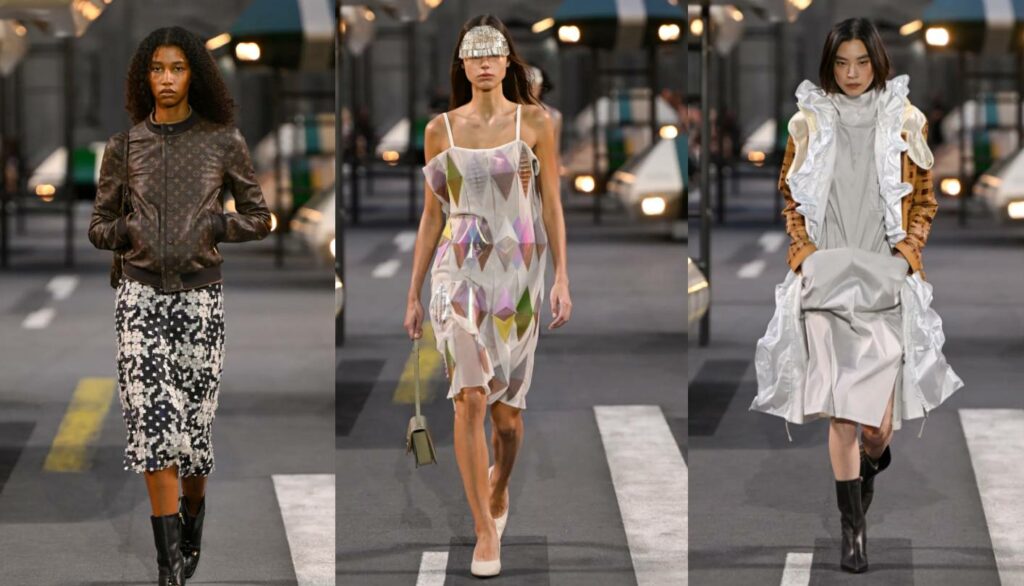
We were promised a collection that would float on air. We were supposed to rise toward the stars, board abandoned spaceships left to our wonder, and take off toward a bright, metallic, desirable future. What we mostly witnessed was a crash. And not just any crash: one in the heart of Paris, beneath the gilding of the Louvre, with Nicolas Ghesquière at the controls and Louis Vuitton as the airline. The ship was meant to aim for the Moon. It mostly managed to circle its own runway.
On Tuesday, October 6, the Carrousel du Louvre was turned into a retro-futuristic racetrack. Why? A mystery. Perhaps because retro-futurism is the new elegant way of saying nothing while pretending to announce tomorrow. Perhaps also because going in circles has become this house’s real concept. Zendaya arrived from her “Holland” (the educated will understand). She wore an outfit that reprised the lace bolero already seen during the promotion of The Odyssey, paired with jeans and a white tank top. So here is the great recycling: the house dresses the actress, the actress recycles her image, and the public applauds the reflection of a reflection. The circular economy of luxury, in short: take back, remix, refurbish, put it back under the lights, and invoice the whole thing as a vision.
On the runway, the future made a timid appearance. Spacesuits, reflective glasses, straight dresses covered in silver lamé. Clothes that look as if they were designed by someone who had heard about tomorrow but had no intention of venturing into it. Everything is clean. Everything is smooth. Everything is flawless. And above all, everything is dead, “Rest in Pet.”
It is a shop-window future, a future under cellophane, a future that threatens nothing, disturbs no one and asks no questions. A perfectly domesticated future, made presentable for the VIP lounges. Because the future must on no account look like the future; it has to be sellable.
In the front row, Emma Stone, Lisa, Catherine Deneuve: a true rocket-launch cast. Except that here, the astronauts don’t take off. They pose. They embody. They certify. And when a house needs such an audience to remind everyone it exists, it may be precisely because it is starting to fear disappearing.
And behind this gigantic staging, there is of course the rocket, and it’s reheated leftovers, since Karl had already thought of it. But this one is Elon Musk’s: the spaceship of billionaires, the great escape fantasy of the privileged. Because that may be the only future this collection truly believes in: a planet burning below, a rocket lifting off above, and a few well-dressed millionaires watching the show from their panoramic porthole.
The rest of us can watch the launch from a Paris sidewalk in 50-degree heat (122°F). The genius of contemporary luxury may lie right there: turning even the climate catastrophe into a product-placement opportunity.
The world is burning? Bring out the lamé. The planet is suffocating? Add reflective glasses. Humanity is questioning its future? Send a few celebrities to the front row. And above all, never utter the word “crisis.” It might crease the satin.
Retro-futurism always ends up exposing its own imposture. It promises us tomorrow with yesterday’s materials, repainted silver. It fantasizes about the future without ever accepting what the future implies: the unknown, fear, rupture and risk.
We watched a collection marking time with an intersidereal arrogance, or rather an “inter-sidering” one (a pun on sidérant, “staggering”). Nicolas Ghesquière obviously knows how to make very beautiful clothes (well, the atelier does!). The mechanics are precise, the construction impeccable, the hand sure. But technical virtuosity is no longer enough to produce a vision, and above all, a beautiful collection.
FM