
FENDI: SOMETHING NEW WITH SOMETHING VERY, VERY OLD
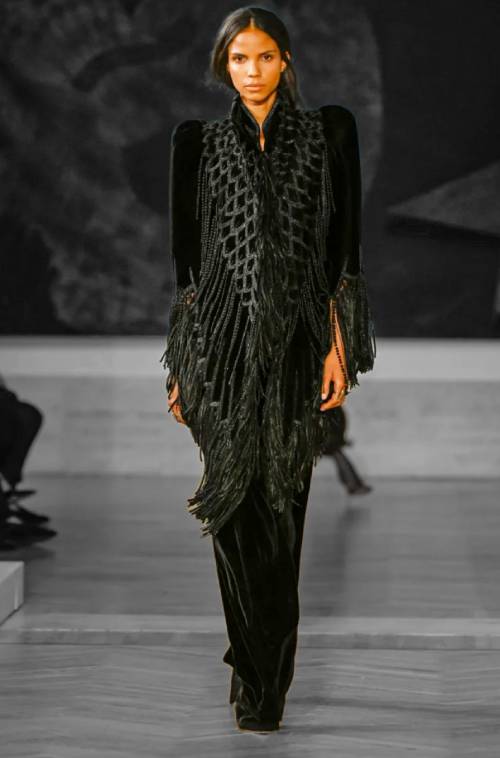
Sit down, we’re going to talk puzzles. Not the kind you shove to the back of the cupboard with 200 pieces missing, no: intarsia, that art form dating back to the 15th century which, unlike certain runway silhouettes, has never needed Photoshop to look timeless.
Here’s the principle, for the culturally illiterate Bimbos at the back of the room: you inlay thin pieces of different types of wood, sanded, carved and fitted down to the micron, not the “Macron,” until you end up with a three-dimensional image.
A 3D puzzle made by an artisan who had neither Pinterest nor an “Instagram deadline,” just the patience required to restore some ancient monastic masterpiece like Madonna, and probably failing eyesight from squinting at walnut shavings until they went down like the Titanic.
Textile intarsia takes that logic and transposes it into wool: unlike good old Fair Isle-style jacquard, where the yarn hangs around hidden behind the work like an ex you just can’t get rid of. Here, every colored section gets its own ball of yarn. No floating threads, no compromises: one color, one ball. Knitting according to the philosophy of “everyone has their place, everyone has their role,” almost a life lesson you could learn in a corporate training session rather than at evening classes at the Baron.
And then Maria Grazia, freshly installed at Fendi, decides to turn the kimono into an Intarsia manifesto. She takes this six-century-old technique, shakes it up, dresses it up, and serves it back as a reinvention of Karl’s legacy. Except that’s where the diatribe begins: intarsia was invented in the 15th century, which, I feel compelled to remind those who were wondering, was not Karl’s era. Although, let’s be honest, in some interviews the man gave the impression that he had personally attended the invention of the spinning wheel or the whip, depending on the day.
Anyway: take an artisan born before the printing press, slip him into a kimono, call it haute couture, and fashion applauds as though nobody had ever heard of a Florentine carpenter with a saw and, above all, far too much free time. Fashion loves this: rediscovering the old in order to look cultured, rebranding it as contemporary genius, and selling nostalgia at a prohibitive price, with presumably a little heritage hidden inside the box. Honestly, hats off, or rather: a château, inlaid, sanded, and sold for the price of a barrel of oil after Hormuz.
But one thing is certain: this is guaranteed oil money for the lord, and Maria is illustrating here, once again, a mechanism of cultural appropriation! In the end, all’s well that Fendi well. But in what world Vuitton!
FM