McQUEEN BETWEEN THE SACRED AND THE UNDERGROUND

McGirr, like all those whom a city has shaped before they shaped themselves, carries within him the remnants of a London glimpsed at seventeen, that age when the soul, still untouched by systems, receives impressions of the world with that exquisite violence which never returns. He wandered through museums as one wanders among tombs, and through nightclubs as though at the borders of a forbidden kingdom; and from this mixture of contemplation and intoxication was born within him an education no school could ever have provided.
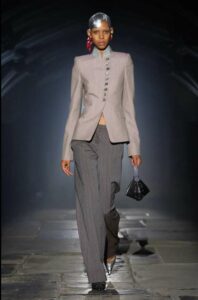
It is thus that, under his hand, clothing became tailoring before it became costume: working with Huntsman, the ancient guardian of the traditions of Savile Row, he refounded British tradition upon principles it had forgotten. The shoulders, seized by a kind of martial modesty, draw inwards and lengthen, until they form an armour in which one might imagine angel wings, folded in expectation of a flight that will never come, condemned to remain upon the earth.
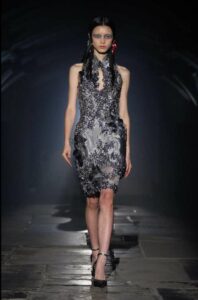
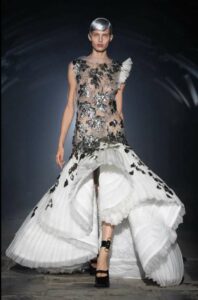
There is, throughout this collection, a perpetual struggle between flesh and iron, between what yields and what resists. Pleated georgette, satin, tulle, lace and transparent veils surround the body in an almost celestial radiance, like the linens in which the figures of altarpieces are clothed; but then leather appears, followed by metal, harnesses, and those shoes of severe architecture that remind us that beauty, in this earthly realm, is never won without some form of defence.
The evening gowns, therefore, far from being those motionless adornments worn for ceremonies, become forms devoted to movement, made for dancing and for the night, as though the fabric itself remembered having once had to flee. And when Shaun Leane, that former collaborator in McQueen’s work, reappears among these silhouettes, one senses a thread being tied once more, a thread one had believed severed by death: his metal does not merely adorn, it inhabits. It coils itself into harnesses, into silver scales scattered as though by the hand of some invisible force, their faint trembling, as the models pass, producing a delicate sound, like those whispers attributed to souls as they cross a room.
And I know of no image that captures this collection more perfectly than that of a being emerging from a nocturnal party at the first light of dawn, still laden with the darkness it is leaving behind, and already touched by a light it had not expected. The wings, the draping, these volumes that protect without imprisoning, this pale metal like moonlight reflected upon water, all conspire to evoke that uncertain moment when the creature of the night still hesitates before becoming an apparition of the day.
It is here, I believe, that the centuries converge: the sacred iconography of the Renaissance, with its solemn stillness, comes to mingle with the subterranean tumult of contemporary London, and from this encounter, as always happens when the past consents to visit the present, emerges a beauty that belongs entirely to neither one nor the other.
FM