LIPA: THE FORGOTTEN STORY
Dua Lipa and the Symbols of Albanian Nationalism: A Pop Star Who Cannot Stay Neutral
Dua Lipa has built an image as an icon of emancipation. Yet on two occasions, her social media posts have revived controversies far heavier than those one expects from a pop star and coffee saleswoman.
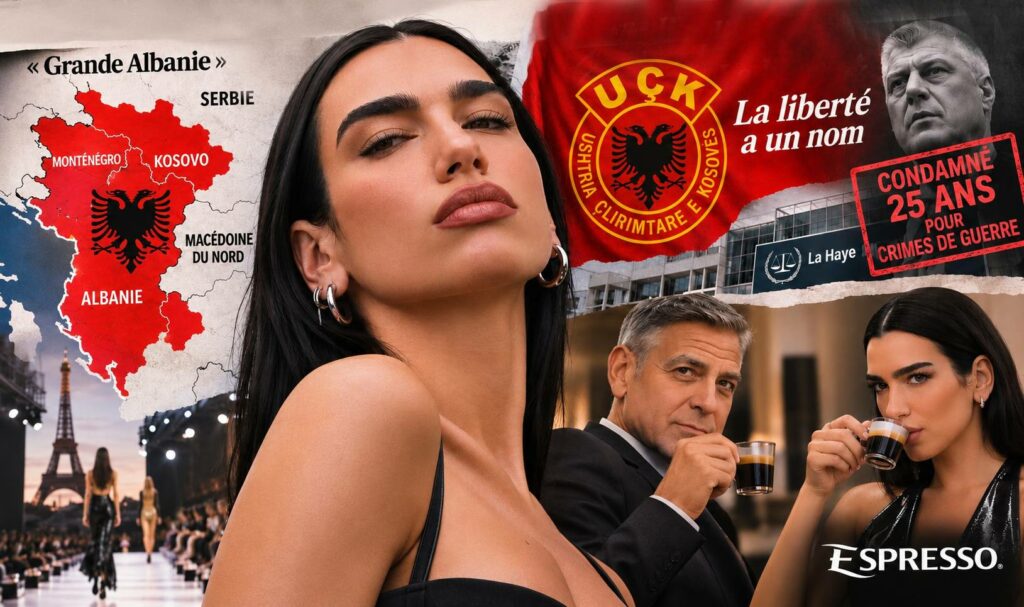
In July 2020, the singer posted a graphic of the territories inhabited by Albanians in the Balkans, accompanied by the definition of the word “indigenous.” This map of “Greater Albania” is a nationalist concept that would have Albania absorb several neighboring territories. The message suggested that the Albanians of Kosovo are indigenous to the region. Critics pointed out that the graphic had already been used in an explosive context: the Serbia-Albania match of October 2014 had to be abandoned. The singer claimed she had been misunderstood and apologized for creating confusion, insisting that her message had never been meant to incite hatred.
In September 2026, after The Hague verdict against former KLA leaders, Dua Lipa shared on Instagram two posts by her father, Dukagjin Lipa, one of them bearing the message “Freedom has a name” and the KLA emblem. Yet Hashim Thaçi, co-founder of the KLA, was sentenced to 25 years in prison for war crimes. Critics argue that displaying the organization’s emblem at the very moment of a war crimes conviction is a loaded choice, coming from an artist followed by tens of millions of people.
Beneath her thick black eyebrows, which seem to slash a severe line across a gaunt face with almost masculine features, the Nespresso ambassador cultivates the cold self-assurance that some celebrities readily mistake for depth. There she is, trading lines with George Clooney in an advertisement where coffee aims to be as refined as the people who serve it.
But had the American actor known of her positions on the KLA, he might have thought twice before sharing the billing. For Clooney, the son of a journalist, grew up in a culture where political awareness is not limited to a few convictions displayed between makeup sessions. His public engagement testifies, at the very least, to a reflection that goes beyond the conveniences of stardom.
There is decidedly an abyss between celebrity and thought, between the elegance one buys with advertising contracts and the far rarer kind that presupposes a conscience. The supermarkets of fame overflow with these showcase beauties who were given an image without anyone asking what they had to say.
An American organization had defended the singer, describing her post as a refutation of far-right theses. Even a critical editorial concluded that she was probably not a nationalist, but that her post was the blunder of an uneducated bimbo. So, since that is how it is, we began inviting her to the Paris Fashion Shows, disregarding all the statements she had made. Fashion is like that: a world of ignoramuses who only think after they have spoken.
FM