
THE LITTLE MARQUISES OF FASHION WEEK
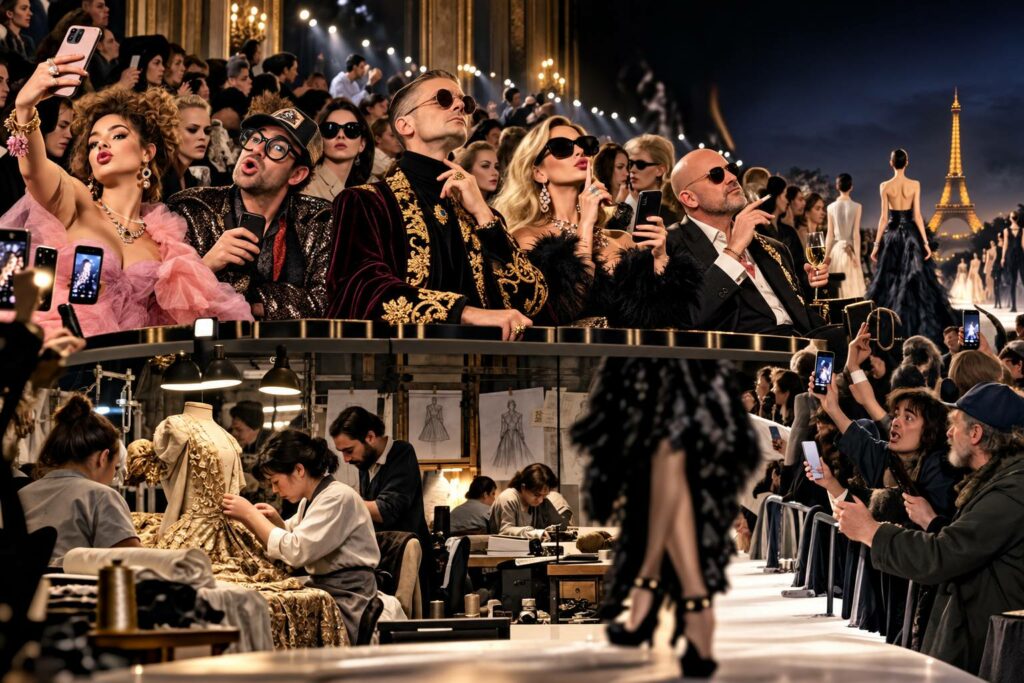
Welcome to Paris Fashion Week, that grand ball of pretension where clothes have become secondary and where what matters is no longer seeing, but being seen. Enthroned in the front row sits Léna Sanitation, empress of the mobile phone, high priestess of Instagram Stories and digital self-glorification. Every appearance becomes an event, every movement a post, every breath another opportunity to produce content.
Not far away emerges Le Flop Flingant, the self-proclaimed journalist and grand interpreter of fashion’s mysteries, all in sixty seconds flat. He comments, he observes, he marvels. His words flow as abundantly as the compliments lavished upon this little court, which so adores hearing its own praises sung a veritable case of intellectual diarrhoea.
But here comes the grand master of ceremonies, Le Petit Page, descended from his native Cévennes to reign over this kingdom of rags and vanities. Imaginary guardian of the temple and master of courtly bows, he bestows his fashionable blessings with the solemnity of a cardinal officiating before an assembly of brainless bimbos.
In his wake appear the demi-mondaines of the new digital aristocracy, among them Philippine le Doigt Désireuse, the very embodiment of a society that delights in confusing an invitation with a coronation, social climbing with legitimacy, as though this ancient ritual had risen from the depths of history.
And what would this comedy be without Pascal Marrant, drawing-room economist and occasional musician? Between two pronouncements on the luxury market and three musical notes, he lends this masquerade the intellectual credibility it so desperately imagines itself to lack.
All these distinguished figures mingle, congratulate one another, exchange kisses and admire themselves in an extraordinary choreography of mutual self-congratulation.
But suddenly, here they come!
The others. The anonymous. The nobodies.
In short, the commoners, the peasants, the great unwashed call them what you will.
Those whose names nobody knows, yet who somehow seem to know every entrance. Those who collect invitations as others collect stamps, photographing the front rows without ever understanding what is happening on the runway.
The only parades they truly know are the queues at the unemployment office, yet they dream of the Saint Laurent runway.
And there they stand, suddenly transformed into fashion critics, experts in elegance and arbiters of good taste, simply because some press officer has granted them a seat at the back of the room.
Meanwhile, as this little court parades, poses and flutters about, somewhere in Paris, hands are cutting, assembling, constructing, sewing, unpicking and beginning again.
Designers are working. Craftspeople are inventing. Workshops are producing the very things that others are so quick to claim as their own, at least symbolically.
For therein lies the great aporia of Fashion Week: those who actually create fashion are sometimes less visible than those who merely come to watch it.
Once upon a time, Paris showcased creations. Today, it showcases reputations.
Fashion was once an art; now it has become a pretext.
The front row was once a seat; now it has become a profession.
And in this immense procession of self-importance, everyone believes themselves indispensable to a spectacle of which they are, in truth, nothing more than spectators.
Fashion Week has not lost its audience. It has simply allowed its audience to mistake itself for the show.
FM